
 E-Paper


Even after the elections, Israel waits for change
The Israelis, whether they voted Right, centre or Left, took this election seriously and believed that this is a decisive moment for the country

 Prefer HTon Google


Newly elected members of the 26th Knesset, Israel’s unicameral legislature, were sworn in on Tuesday, with President Isaac Herzog calling for, among other things, the parliament to ensure “national unity and stability”.
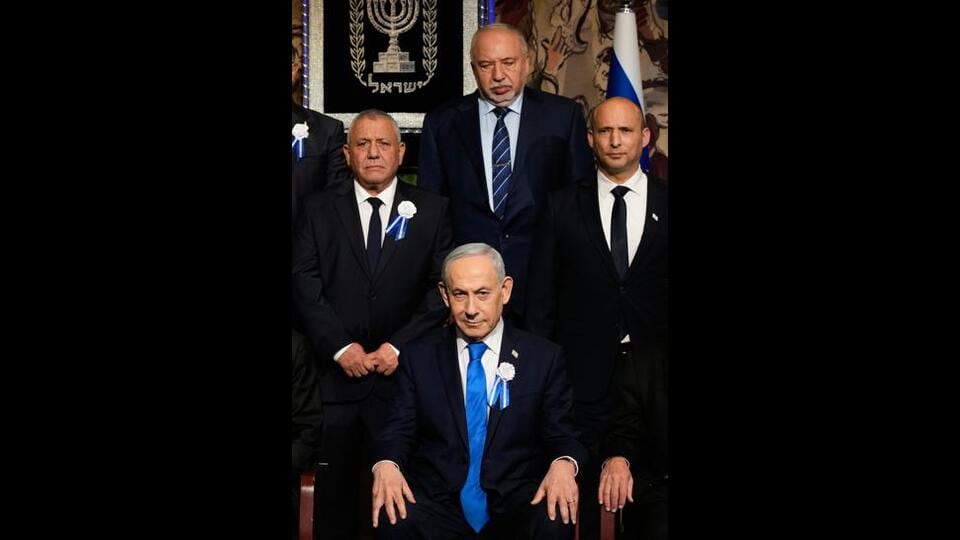
The backdrop to this call makes it more than a routine appeal. The country’s national elections, which took place on October 27, delivered an outcome that none of the country’s political parties liked: No one emerged as the winner. After the country’s election regulator announced the official results on November 4, incumbent Benjamin Netanyahu’s pre-election coalition bagged 53 seats. The Opposition bloc, led by Gadi Eisenkot, bagged 48 seats as a pre-election coalition. Meanwhile, Israel’s Arab parties — Ra’am and Joint List — picked up 19 seats. Herzog has now invited Eisenkot to form the next government. However, this still remains one of the trickiest moments in Israel’s recent political history — the Arab parties needed to make up the numbers have not been part of any government, except the one led by Naftali Bennett, in 2021.
Israel has been administered by coalition governments since its founding. But, over the past few years, this has become increasingly difficult due to intense internal sociocultural divisions and clashing interests of various groups within the majority, the Jews. Arab Israelis are a significant minority (around 21% of the country’s 10 million population). They have equal political and legal rights; they can vote, contest, and win seats in Israeli elections. But it remains a taboo for Jewish parties — irrespective of where they are on the politico-ideological spectrum — to be in a coalition because of the fraught relations between the communities. Most Arabs are Muslims; some are Christians, Druze or Bedouins. The Muslim segment does not serve in the Israeli army due to their ambivalent positions on Israel as a State of/for Jews or because of the historical conflict with the Palestinians, including the ongoing war.
Now, the Opposition bloc against Netanyahu must either take the risk of normalising the relationship with the Arabs and govern the country with their continued support or face another national election in six months. This evokes a sense of déjà vu. Between 2019 and 2022, Israel saw inconclusive results and held five national elections. The Netanyahu government rose to power after those unstable times, with a thin majority at the end of 2022. Whether the Opposition bloc can cross the Rubicon was the big question as multiple public rallies were conducted in Tel Aviv — where protests against Netanyahu had become usual — demanding an Arab-Jewish alliance, which has now materialised.
Arab leaders such as Yousef Jabareen, an academic, and Monsour Abbas, a dentist, have been the voice of Arab-Israelis in the Knesset for multiple parliamentary terms. They said they support Eisenkot in forming the government. They see the Netanyahu-led dispensation as having been negligent in addressing the core, everyday concerns of their community, such as high crime rates and an indifferent, even cold, police force; racism; and shortage of development funding for their areas. Given the weight of their concerns when it comes to their community’s well-being, they have toned down their opposition to the idea of Israel as a State of/for the Jewish people and the actions of the Israeli forces in Gaza and the West Bank. They know they are not in an easy position, but wish to lead Israel’s Arab community out of the deep distrust it harbours for the country’s majority community. They wish for their community to be heard in Israeli politics as an equal, and not remain untouchable.
The Israelis, whether they voted Right, centre or Left, took this election seriously and believed that this is a decisive moment for the country after three years of the October 7 Hamas attack and the ensuing work.
Several issues dominated the elections this time, unlike in the past two decades. Why Israel failed to defend itself on October 7 remains a key question. Voters also asked if the country was any safer after fighting multiple wars in the region, against Hamas in Gaza, Hezbollah in Lebanon, Houthis in Yemen, and, most consequentially, Iran. Apart from war concerns, Israeli society has seen critical, identity-linked tensions between Ashkenazi (European-origin) and Mizrahi (West Asian/Asian-origin) Jews, as well as schisms between the peaceniks who support the two-State solution for Palestine and restraining militarism and the hawks who believe in peace-through-strength and security maximisation.
Each of these groups was vocal, mobilised, and pushed to give a good fight in the general elections last month. A few months ago, when Israel and Iran were locked in a war, the chances of this election happening were slim. Holding the elections in a controversy-free, incident-free manner, without delays, was certainly an achievement for the country’s political system and bolstered its democratic credentials.
Israel, as a State and as a society, stands at a critical juncture in history. Its people are exhausted with the wars of the last three years, and its diplomatic reach is shrinking as a growing list of western powers (some of them historical allies) impose sanctions on the country for occupying Gaza and the West Bank. There is deep polarisation when it comes to the current Israeli dispensation among Americans; this became all too apparent in the recent midterm elections in the US. Jews, in general, are experiencing a surge in anti-Semitism. Israel’s domestic matters as well as its external relations both demand immediate course correction. A new leadership may lead it down that path.
Khinvraj Jangid is professor and director at Jindal Centre for Israel Studies, and founding-chair of India-Israel Centre, New Delhi. He’s a Comper Fellow at the Elizabeth and Tony Comper Centre for the Study of Antisemitism, University of Haifa, Israel . The views expressed are personal


