
 E-Paper



Ganesh Chaturthi 2026: Should homebuyers opt for payment plans over property freebies this festive season?
This Ganesh Chaturthi, Mumbai real estate developers are using flexible payment plans to ease buyers’ upfront cash-flow burden without reducing headline price

 Prefer HTon Google


Ganesh Chaturthi is traditionally seen as an auspicious window for buying property in Mumbai, with developers using the festive season to sweeten deals and nudge homebuyers towards a purchase. But this year, the pitch is changing. The glitter of gold coins, stamp-duty waivers and overseas holidays is giving way to a more practical proposition, greater payment flexibility, from Buy Now, Pay Later (BNPL) to staggered and deferred payment plans.
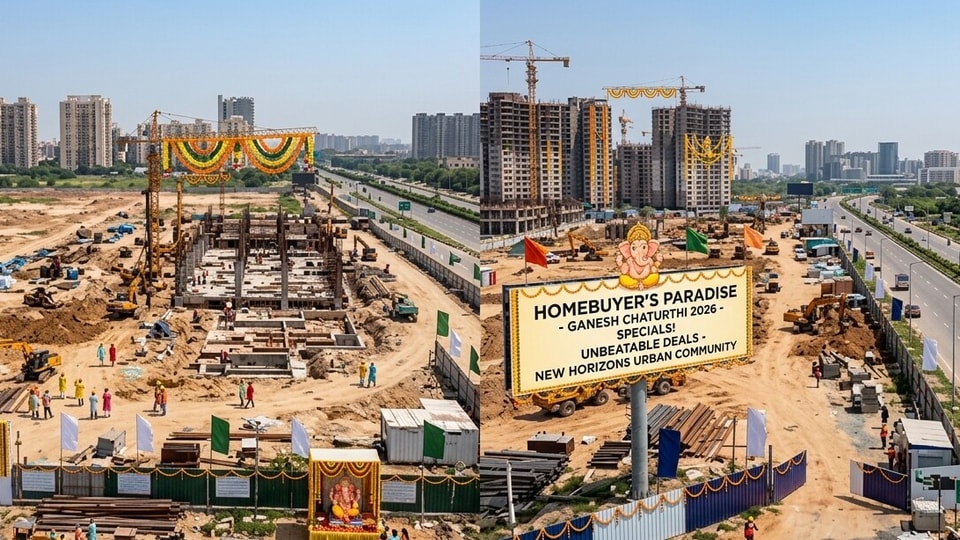
Mumbai-based Sayaji Realty, for instance, is offering special payment plans on its premium residences. At its Mio Solace project in Khar West, a 3 BHK priced at ₹6.5 crore comes with a 10:90 payment plan, under which buyers pay 10% upfront and no EMI until possession. At Mio Miraya, its 4 BHK residences priced at ₹12.24 crore, buyers can pay 10% upfront and defer the remaining payment for a year without EMIs.
Real estate experts say that continued transaction activity during the festive season gives developers scope to convert existing buyer interest through more flexible commercial structures.
Ashish Narain Agarwal, founder and managing director of PropertyPistol, said the festive season is seeing a clear shift from traditional giveaways towards offers that provide greater financial flexibility. Developers are increasingly using construction-linked payment plans, deferred or staggered payments, limited-period price benefits and selective support on transaction-related costs to encourage buyers to close deals during the festive period.
“This reflects a more evolved buyer mindset, where decisions are increasingly driven by location, connectivity, project quality and long-term value rather than discounts alone,” Agarwal said.
Deepak Khandelwal, Principal Partner and Chief Sales Officer, Square Yards, agrees. Festive offers in Mumbai are increasingly shifting towards payment flexibility and reducing the immediate cash-flow requirement for buyers. Construction-linked payment plans, deferred-payment structures, lower initial booking commitments and milestone-based payments are becoming more prominent, particularly in higher-ticket projects where the upfront financial commitment can be substantial.
Traditional festive incentives such as gold, stamp-duty benefits, and lifestyle-related rewards continue to be offered selectively in the market, but payment flexibility has become a more meaningful proposition for buyers. It allows developers to make the purchase easier to manage without necessarily reducing the property's headline price, he explains.
The backdrop remains supportive for festive sales. Maharashtra recorded 12,503 property registrations in August 2026, an 11% increase over the same month last year, with stamp-duty collections rising 12% to ₹1,123 crore, according to registration data. Mumbai had also recorded 4,392 registrations during Ganesh Chaturthi in 2025, up 29% from the corresponding festive period a year earlier. This continued transaction activity gives developers scope to use the festive period to convert existing buyer interest through more flexible commercial structures.
Also Read: Mumbai real estate market reports 12,503 property registrations in August 2026, up 11% YoY
Is Buy Now, Pay Later suitable for you?
A BNPL or flexible payment plan allows buyers to pay a smaller portion of the property value at booking and defer the remaining payment until possession or construction milestones. Developers use these schemes to help buyers lock in current prices without arranging the entire amount upfront.
However, such plans may not suit every buyer. For those relying on home loans, deferring payments can increase the overall financing cost. For buyers who are partly self-funded and expect liquidity from the sale of an existing property or investments, the flexibility can provide valuable breathing room.
Deepak Khandelwal says that the real estate market is moving towards financial flexibility, although it would be too early to say that traditional festive incentives have been completely replaced. The nature of the incentive is changing because, at today's property prices, the timing of the payment can have a much more meaningful impact on a buyer's decision than a one-time gift.
Deferred-payment and construction-linked structures effectively reduce the immediate capital requirement and can make it easier for buyers to enter the market while payments remain linked to project milestones. This is particularly relevant for buyers who have the capacity to purchase but prefer to align their cash outflow with the construction and possession cycle.
What should homebuyers keep in mind before investing this festive season?
Festive real estate offers in Mumbai this season are taking two distinct routes. The traditional approach is to add a little extra to the deal, gold coins, vouchers and purchase-linked rewards that bring an immediate festive appeal. The newer, and perhaps more meaningful, proposition is to make the purchase itself easier to finance, through lower upfront payments, construction- or milestone-linked instalments and deferred payments.
“The distinction matters. While a freebie adds a perceived benefit to the purchase, payment flexibility can directly ease the burden on a homebuyer’s cash flow. In a high-value market such as Mumbai, that could make flexible payment plans more compelling for serious buyers who are looking at a property not just as a festive purchase, but as a long-term financial commitment,” Agarwal said.
Agarwal said festive offers should be viewed as an opportunity to negotiate better rather than as a reason to rush into a purchase. The fundamentals of the property should remain the starting point.
Buyers should assess the micro-market’s growth potential, redevelopment activity, infrastructure connectivity, employment hubs, and civic infrastructure, while independently verifying MahaRERA disclosures, title documents, approvals, construction progress, and possession commitments. They should also calculate the total acquisition cost, including taxes, registration, maintenance, and other applicable charges, and compare the offer with competing projects.
According to Khandelwal, buyers should distinguish between a genuine saving and a payment deferral. A flexible plan may improve cash flow without necessarily reducing the property's overall cost. The final consideration payable, financing costs, payment milestones and associated charges should therefore be compared with the standard payment structure before assessing the actual benefit.
Buyers should also consider the total cost rather than the advertised price or discount. Parking, floor-rise charges, maintenance deposits, registration, stamp duty and other applicable charges can materially change the final acquisition cost. For a flexible payment plan, the construction-linked schedule, financing cost, possession timeline and implications of delayed payments should also be clearly understood.
RERA disclosures are particularly important during the festive period because buyers can verify the sanctioned plan, carpet area, project specifications and declared completion timelines before committing. The developer's execution track record and the project's construction progress should carry greater weight than a limited-period festive incentive, says Khandelwal.
Ultimately, the festive season can be a good time to negotiate a better entry price or payment structure, but the investment case should continue to rest on location, pricing, developer credibility, construction progress and long-term demand. A festive offer can improve the economics of a good property; it should not be used to justify a property whose fundamentals do not work, he added.


