

 E-Paper



No clear election majority, coalition talks, president's intervention: Where Israel stands
Israel went to the polls on October 27, the first time since the war on Gaza and other conflicts began in 2023.

 Prefer HTon Google


The highly anticipated results for the Israeli elections 2026 will be declared on November 4. With no clear majority secured by the blocs led by incumbent Benjamin Netanyahu and Gadi Eisenkot, all parties are working towards establishing a coalition.
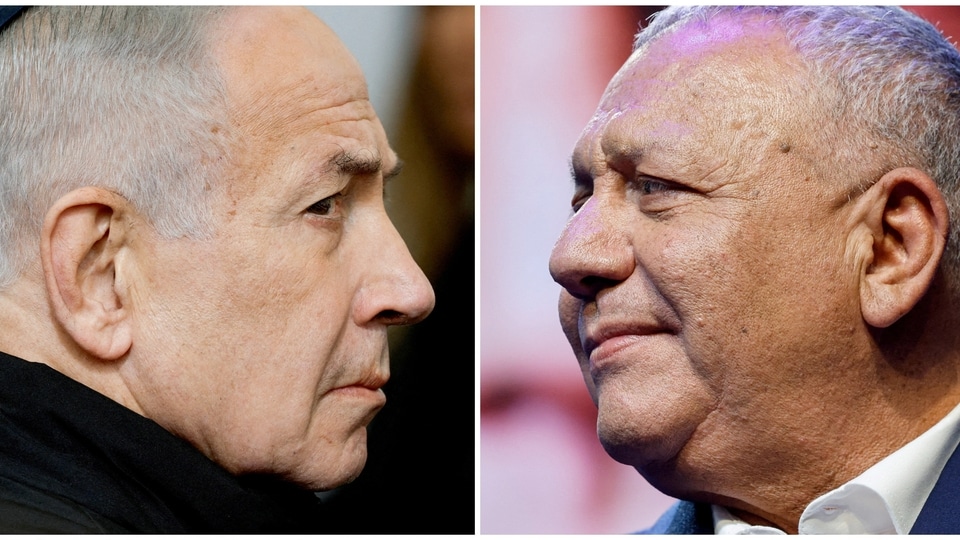
Israel went to the polls on October 27, the first time since the war on Gaza and other conflicts began in 2023. The voter turnout was recorded at 77.9%, the highest since 1999.
Where each bloc stands
As per Israel's Central Election Committee, the Netanyahu-bloc has secured 53 seats and Eisenkot bloc has secured 48 seats. For any bloc to win, they must secure a total of 61 seats in the 120-member Knesset, the Israeli parliament.
Meanwhile, Israel's Arab parties - the Joint List (a coalition of Hadash, Ta'al and Balad) and Ra'am, have secured a record of 19 seats, making them key players in the election.
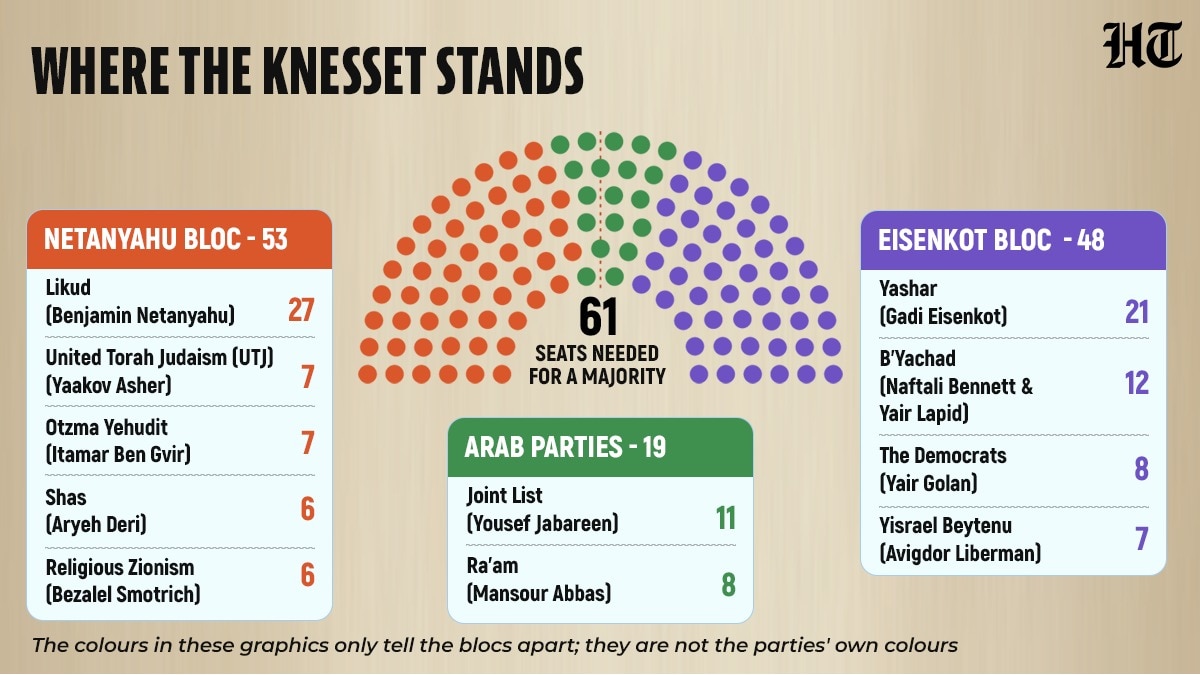
A party needs at least 3.25% of the valid votes nationwide to win any seats in the Knesset.
What happens next?
The official results will be published on November 4 in Reshumot, Israel's official gazette. After this, President Herzog is expected to begin consultations. Delegations from every party that won seats will visit the President's Residence in Jerusalem and recommend a name for the post of the prime minister.
After the publication, a seven-day deadline comes into focus, meaning that a decision regarding the new government must be taken latest by November 11.
During these negotiations, the lawmaker, which Herzog thinks has the strongest chance of forming a government, will be called. The prime ministerial candidate need not be the leader of the largest party.
According to Ynetnews, Yashar, B'Yachad, the Democrats, the Joint List and Ra'am are expected to recommend Eisenkot, who is likely to bag the support of 60 seats. B'Yachad has also confirmed its support for Eisenkot. Likud, Otzma Yehudit, Shas and Religious Zionism are expected to recommend Netanyahu, forming a total of 46. Yisrael Beytenu and UTJ (14) have not decided, and UTJ is reportedly weighing recommending no one.
Also Read | Naftali Bennett's faction backs Gadi Eisenkot for PM as Netanyahu struggles to form Israel's next government
Once the first candidate is called, the lawmaker has 28 days to form the government. As per Basic Law, this deadline can be extended by another 14 days.
If the first candidate fails, the Israeli president has two options - the task can be given to another lawmaker or the Knesset Speaker is told that there is no chance of anyone forming a government.
In the first option, the second candidate gets 28 days to form the government, but no extensions.
In case of the second option, the Knesset gets one last try where for 21 days, any 61 of its 120 members can sign a written request asking the president to give the task to a particular lawmaker who has agreed to take it on. If they do, that lawmaker gets 14 days to form a government.
If this also fails, the Knesset is dissolved and a fresh vote will be held.
Netanyahu, Eisenkot or no government? What could happen
There are a total of seven scenarios as Israel moves to form its 26th Knesset.
Scenario 1 - Unity government under Netanyahu
Likud governs with Yashar, B'Yachad and Yisrael Beytenu, with Netanyahu as prime minister. Otzma Yehudit, Religious Zionism, the ultra-Orthodox and the Arab parties stay out. The Times of Israel describes these four as the centre-right parties that together won a substantial share of seats.
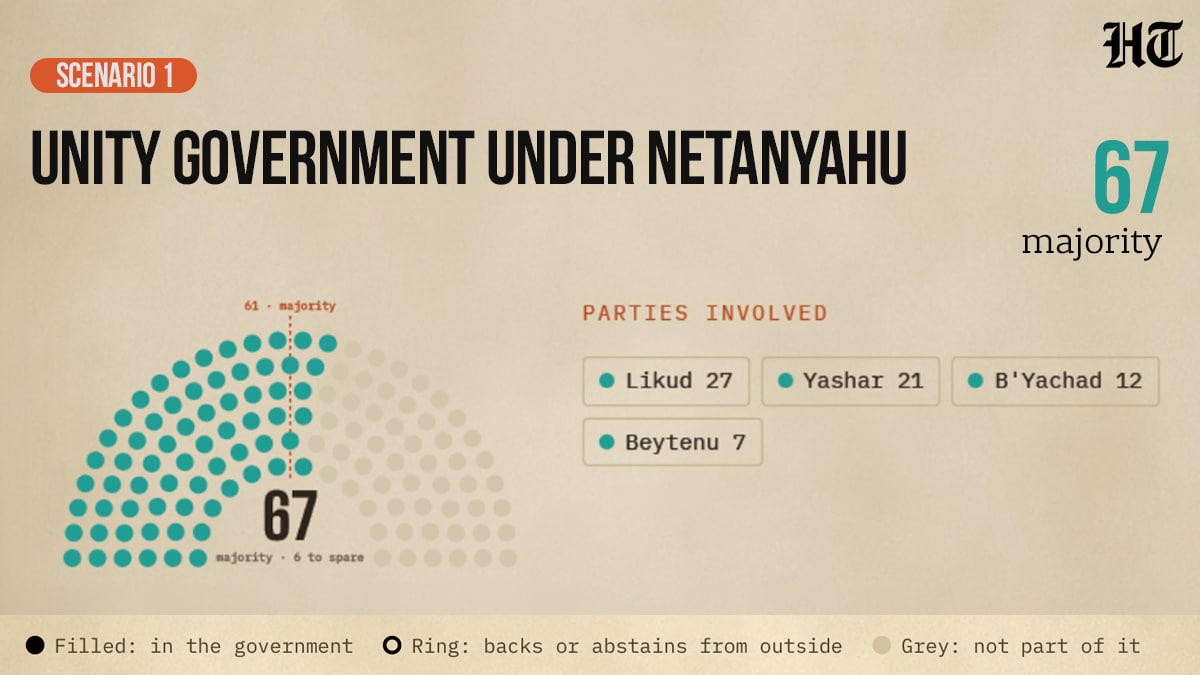
However, there is a catch - Netanyahu would have to break his pledge to govern with his existing allies, and Gadi Eisenkot, Naftali Bennett, Yair Lapid and Avigdor Liberman would have to break their pledge never to serve under Netanyahu. President Herzog has reportedly wanted a unity deal from the start, which his office denies. Liberman reportedly wants Eisenkot to join Netanyahu but won't do so himself.
Scenario 2 - Unity government with Netanyahu first in a rotation
Netanyahu and Eisenkot would take turns as prime minister, with Netanyahu going first. There are two versions. According to Ynetnews, Likud would share power with the whole change bloc. In a version briefed to the Jerusalem Post by people close to Netanyahu, Eisenkot takes over after about two years, and the government starts with just Likud, Otzma Yehudit, Religious Zionism and Yashar. The ultra-Orthodox parties would join only after it passes a military-service law. That line-up adds up to exactly 61 seats, and it is the one shown on the chart.
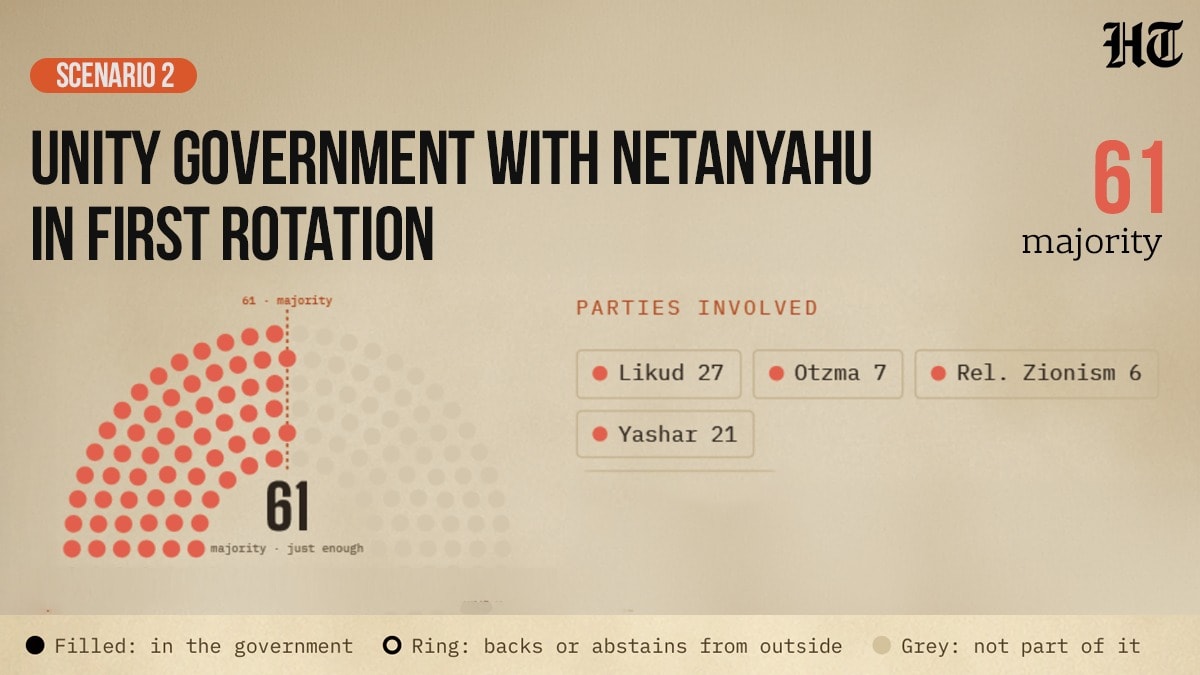
The catch - Eisenkot has ruled it out: “I unequivocally pledge that I will not serve under Netanyahu in a rotation agreement. Period.” Likud has also rejected it. “We oppose rotation, after the election results showed a high level of confidence in us,” Likud whip Ofir Katz told Army Radio on November 1.
Scenario 3 - Netanyahu forms the government with defectors from the Change bloc.
In this scenario, Netanyahu keeps his alliance and lures at least eight lawmakers away from the opposition, mainly from Eisenkot's Yashar. Likud has reportedly set up a special team to persuade them. This route also needs UTJ to stay put. Its loyalty is in doubt. UTJ sources say the alliance with Netanyahu has run its course, and the party wants a draft-exemption law before it commits to any government.
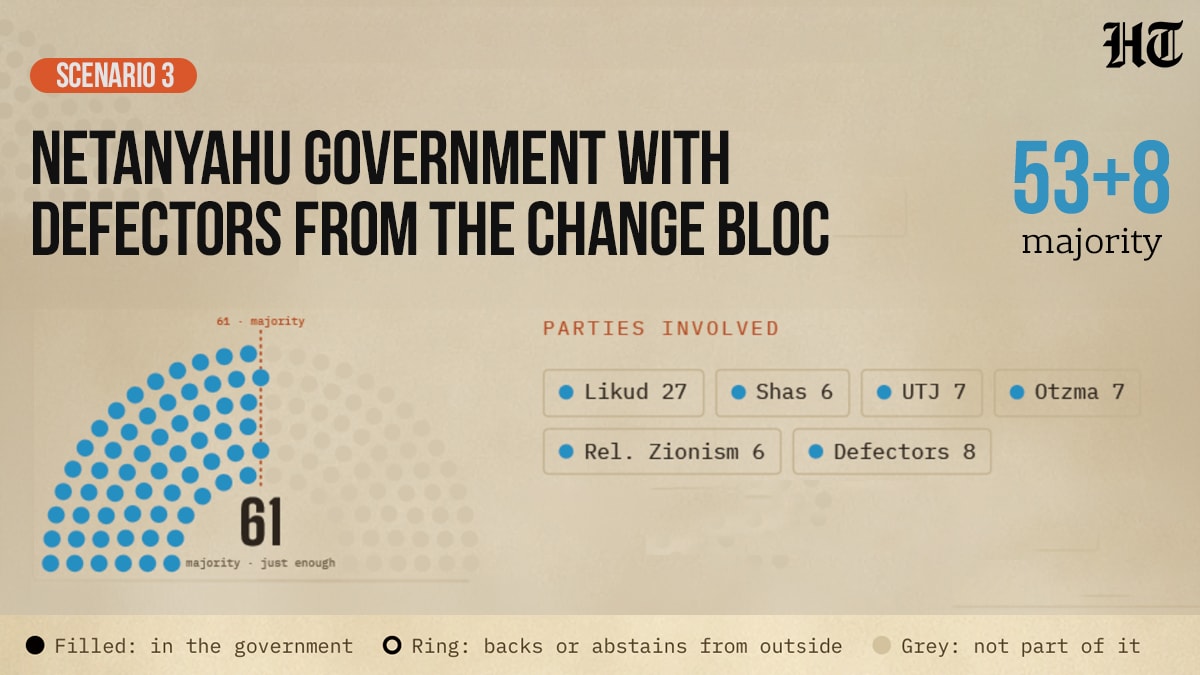
However, defectors would have to break campaign pledges not to serve under Netanyahu or alongside the ultra-Orthodox parties.
Scenario 4 - Eisenkot forms the government with Netanyahu ally UTJ
United Torah Judaism, an ultra-Orthodox party that has backed Netanyahu for years, is reportedly offering to let Eisenkot govern. It would stay out of the government and abstain instead of voting against it. According to Ynetnews, a senior UTJ official said: “We are offering him the premiership. That's better than being No. 2 or going to another election.” Without UTJ, Netanyahu's camp has 46 seats, so Eisenkot's 48 could win a confidence vote as long as the Arab parties do not vote against him. According to Ynetnews, Eisenkot has authorised an examination of a government formed with UTJ and Ra'am abstaining.
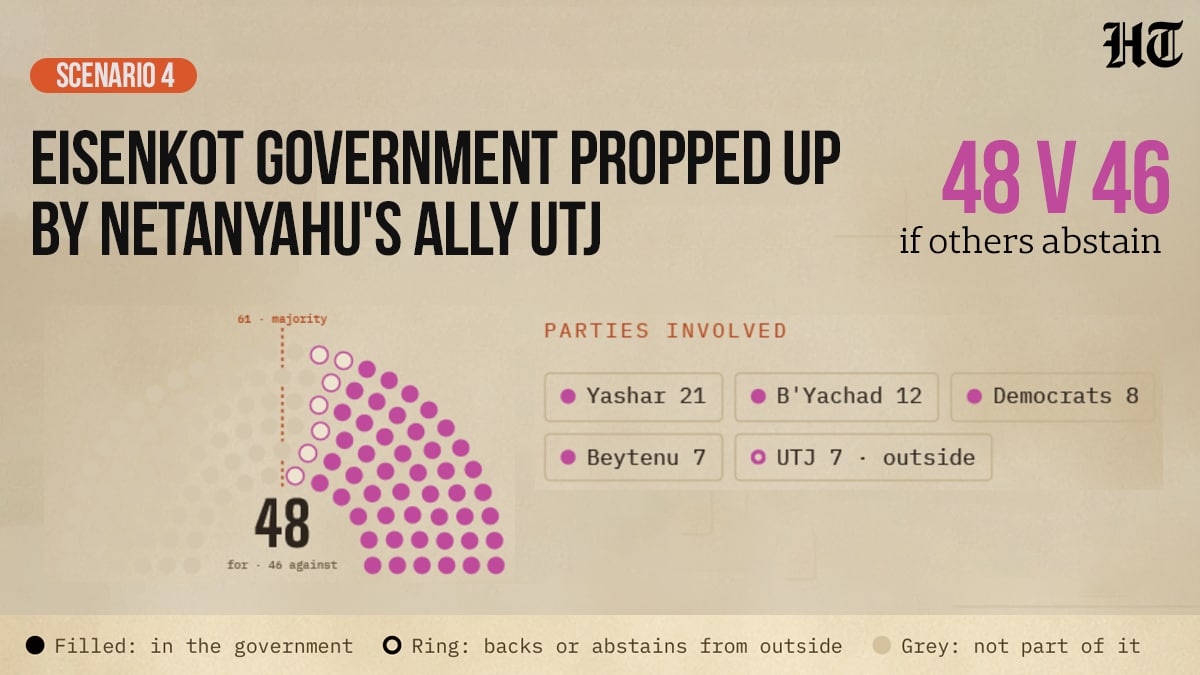
However, the UTJ would join only if a deal on military draft exemptions for young ultra-Orthodox men in religious seminaries (yeshivas) is made. Most Jewish Israelis must serve. One UTJ official said the party could join the government once a conscription law passes.
The catch? Eisenkot's core campaign promise is national service for all, the opposite of what UTJ wants. Liberman reportedly opposes forming a government with the ultra-Orthodox parties, and without his 7 seats Eisenkot's side drops to 41, fewer than the 46 against.
The reports rely on unnamed UTJ sources. Party chairman Yaakov Asher says UTJ is “not currently talking in terms of blocs.
Scenario 5 - Temporary minority or caretaker government led by Eisenkot
With this, Gadi Eisenkot forms the government, but a minority one due to his bloc securing 48 seats. However, if both Arab parties - Joint List and Ra'am back the Eisenkot bloc from outside without formally joining, that would give Eisenkot 67 votes against 53 in a confidence vote, even though it holds fewer than 61 seats itself.
According to Ynetnews, a short-lived version is also possible: replace Knesset Speaker Amir Ohana, set up an inquiry into the October 7, 2023 attack, then dissolve the Knesset for a fresh election.
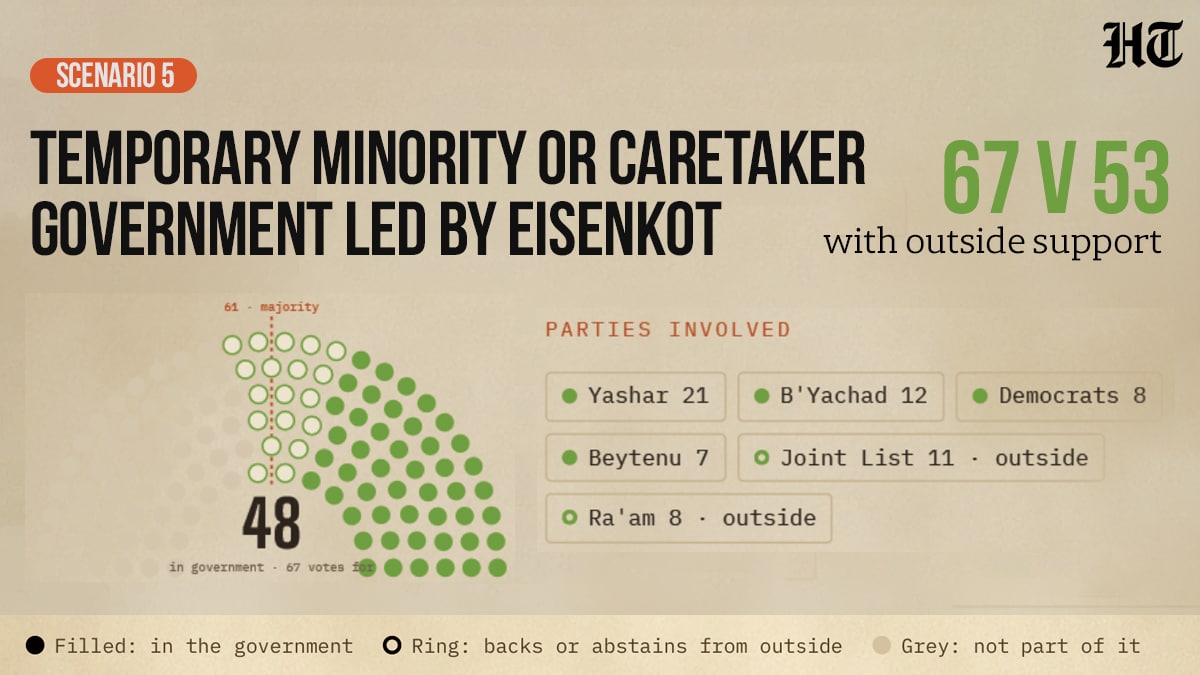
But there is yet another catch, every change-bloc leader except the Democrats' Yair Golan promised not to rely on Arab parties. Bennett and Liberman oppose it, and Eisenkot has said no Arab party meets his conditions. Ra'am did join the Bennett–Lapid government in 2021, which collapsed about a year later.
Scenario 6 - Eisenkot forms the government with Ra'am.
This scenario would be a rerun of 2021, when Mansour Abbas's Ra'am joined the Bennett–Lapid government. The coalition would have 56 seats. If the Joint List backed it from outside or abstained, 56 votes for would beat 53 against.
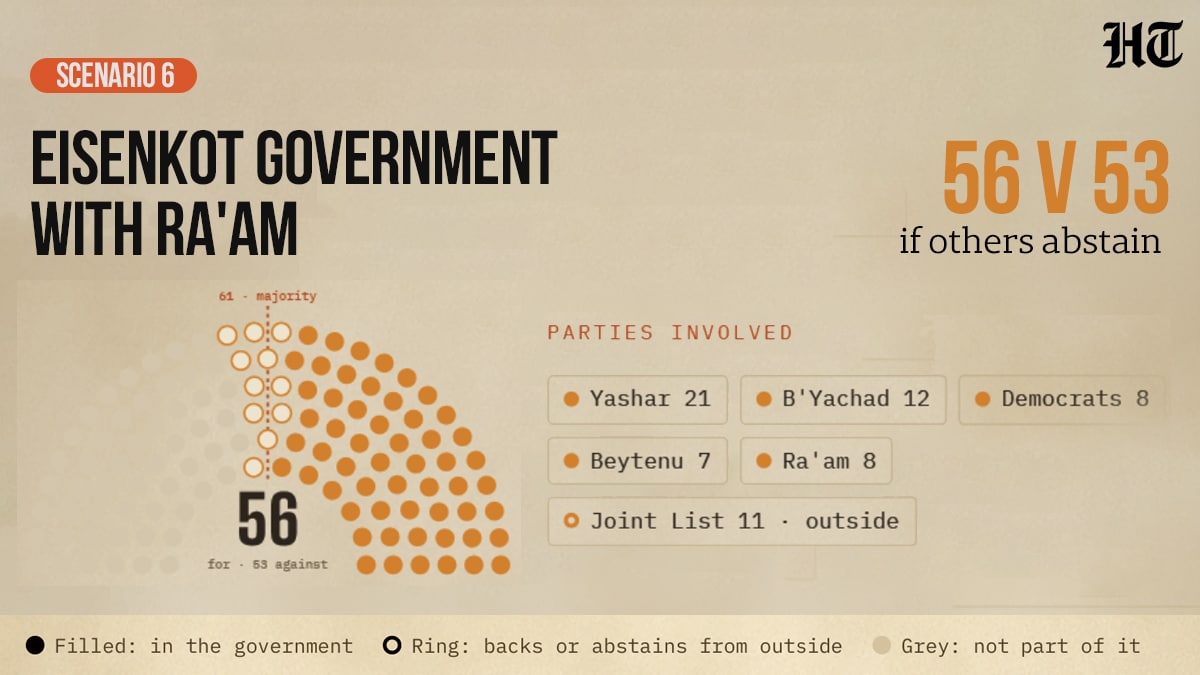
But it seems unlikely, because Liberman rules out any government that leans on Arab parties, even temporarily. Abbas himself now says a minority government is unlikely.
Scenario 7 - A fresh vote
If all roads fail, the Knesset dissolves automatically and Israel goes to the polls again. This remains the only outcome in which no leader breaks a campaign promise.
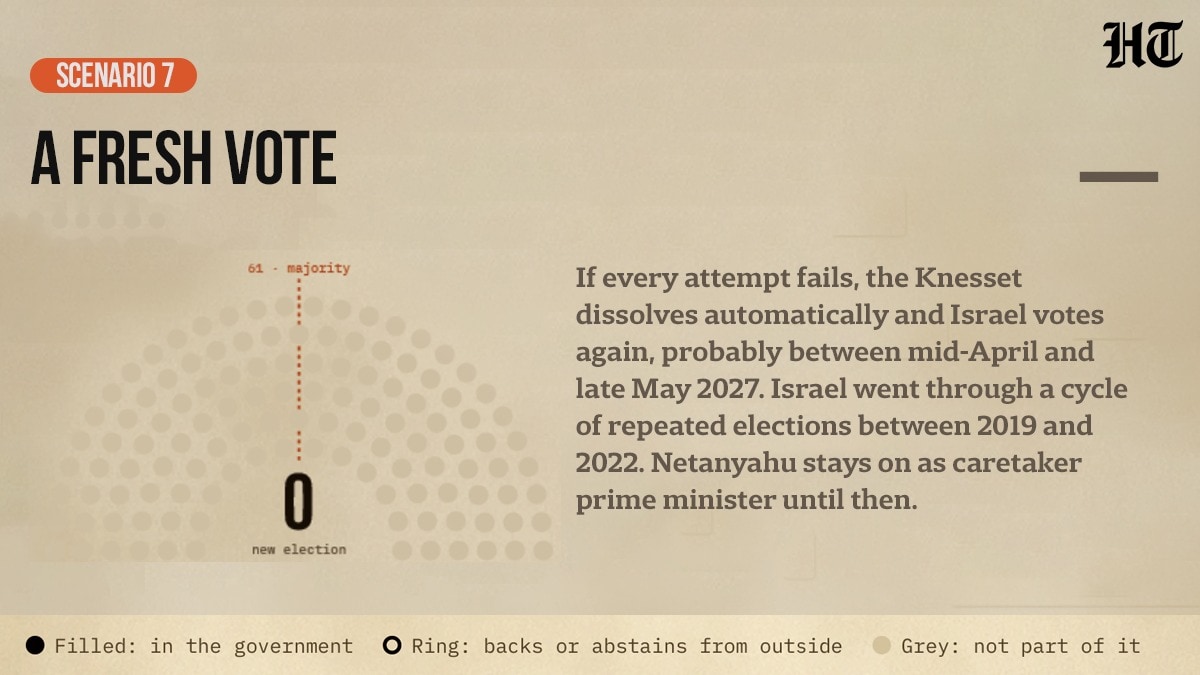
These elections, if held, would probably be between mid-April and late May 2027, and Netanyahu stays on as caretaker prime minister.


