
 E-Paper


Punjab farm fires cross 5,000 mark; 1,100 FIRs lodged so far
Authorities have marked 1,342 red entries in land records of violators and imposed nearly ₹80-lakh environmental compensation

 Prefer HTon Google


Punjab Police have registered more than 1,100 FIRs and marked over 1,300 “red entries” in farmers’ land records this paddy harvesting season, even as the number of stubble-burning incidents in state crossed 5,000 and edged closer to last year’s total.
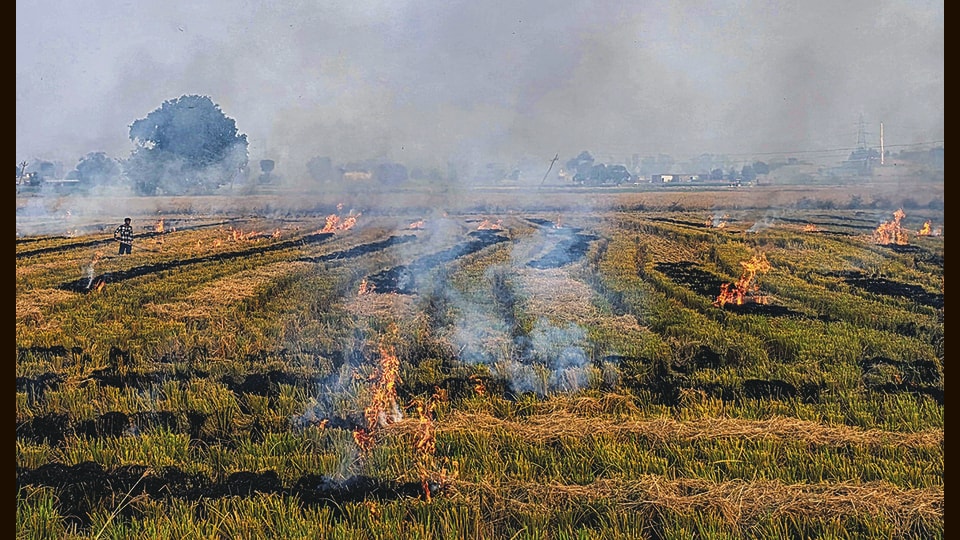
According to the latest data compiled by the Commission for Air Quality Management (CAQM), the state reported 345 fresh farm fires, taking the cumulative count to 5,002. With 20 days remaining in the 2026 monitoring period, the figure is just 112 short of the 5,114 incidents recorded during the whole of last year.
Stubble burning in Punjab and Haryana is often blamed for worsening air pollution in Delhi-NCR. With a narrow window to prepare fields for the next crop of wheat after the October-November paddy harvest, some farmers burn crop residue to clear their fields quickly. The annual farm-fire monitoring period begins on September 15, two weeks before paddy procurement starts on October 1.
Punjab had recorded 4,195 incidents by November 10 last year, making this season’s count nearly 20% higher. The sharpest single-day spike this season came on Diwali, when 1,152 incidents were reported.
The CAQM data, based on satellite tracking by the Indian Space Research Organisation (ISRO), showed that 1,155 FIRs had been registered this season under Section 223 of the Bharatiya Nyaya Sanhita (BNS), which deals with disobedience of orders promulgated by public servants and provides for imprisonment of up to one year and a fine of ₹5,000.
Authorities have also marked 1,342 red entries in the land records of farmers who burnt crop residue. Such entries can prevent farmers from obtaining loans against their agricultural land or selling it. Environmental compensation totalling ₹79.75 lakh has been imposed in 1,574 cases, of which ₹36.50 lakh has been recovered.
The state recorded 5,114 farm fires in 2025, compared with 10,909 in 2024 and 36,663 in 2023.
The enforcement data also showed that 1,103 showcause notices had been issued to officials responsible for monitoring farm fires, while 18 prosecutions had been initiated. No suspensions or formal charge sheets had been processed.
Enforcement a tough task
Officials said taking action against farmers for stubble burning remained difficult, despite pressure from central agencies.
“There is tremendous pressure from the central agencies — the Commission for Air Quality Management and the National Green Tribunal — but farmers in Punjab comprise a strong and large pressure group,” said an official in the science and technology department, under which the Punjab Pollution Control Board functions, requesting anonymity.
“Farmers who face FIRs have to visit the courts repeatedly, which is an ordeal, but none have been convicted so far,” said another senior agriculture department official.
District administrations have established a monitoring chain headed by deputy commissioners, followed by sub-divisional magistrates, supervisory officers, cluster heads and nodal officers. The latter are responsible for monitoring one or two villages, depending on the size of the agricultural land.
However, “nodal officers cannot stay in the villages because of fear of the farmers,” the agriculture department official said.
Sukhwinder Singh of the Bharatiya Kisan Union (Rajewal), who works in Samrala, said farmers were educated about the consequences of burning crop residue, but enforcement remained difficult. “We educate farmers not to burn crop residue, yet in case anyone resorts to burning due to different reasons, we do not let them be penalised,” he said.
Another agriculture department official questioned the effectiveness of red entries, claiming that farmers marked in the land records continued to access loans. “I have not heard that any farmer’s crop loan has been stopped,” he said.
Farm fire count down 95% in 6 yrs: Punjab minister
State minister Aman Arora, on his part, said the sustained efforts of the AAP government have brought the far fire count down by 95% in six years.
“Punjab had recorded 83,002 stubble-burning incidents in 2020, which declined to 5,114 in 2025. The number had further fallen this time, marking a nearly 95% reduction compared to 2020,” said Arora. This remarkable reduction has been achieved because the Bhagwant Mann-led AAP government has provided farmers with practical alternatives and necessary resources, he added.
He accused the BJP of defaming the Punjab farmers. “Instead of recognising these efforts, the BJP is deliberately running a campaign to defame the very farmers who have made such a significant contribution towards reducing stubble burning,” he said.
Highlighting the state government’s efforts, Arora said that more than 1.60 lakh crop residue management machines had been provided at subsidised rates to farmers, panchayats, farmer producer organisations (FPOs) and custom hiring centres since 2022. Of these, 25,917 machines had been provided during the current year alone.
According to the figures procured from the department of science and technology, nearly 70 lakh tonne of paddy straw is being consumed in boilers and pellet industry. Nearly 50-60 lakh tonne is mixed in the soil (in-situ management) and agriculture department estimates that rest is set on fire. (With inputs from HTC Sangrur).


