
 E-Paper



Garbage crisis in Delhi as overflowing dhalaos trigger jams, attract strays
Delhi generates over 13,000 tonnes of waste daily, while ageing equipment and delayed contracts hamper collection across several zones.

 Prefer HTon Google


Garbage spilling out of dhalaos on to roads. Commuters stuck in traffic jams. Heaps of waste raising a stink in public spaces. Cows and dogs feeding on exposed food waste, overflowing sites because of a shortage of bins, and informal waste-pickers working without formal integration.
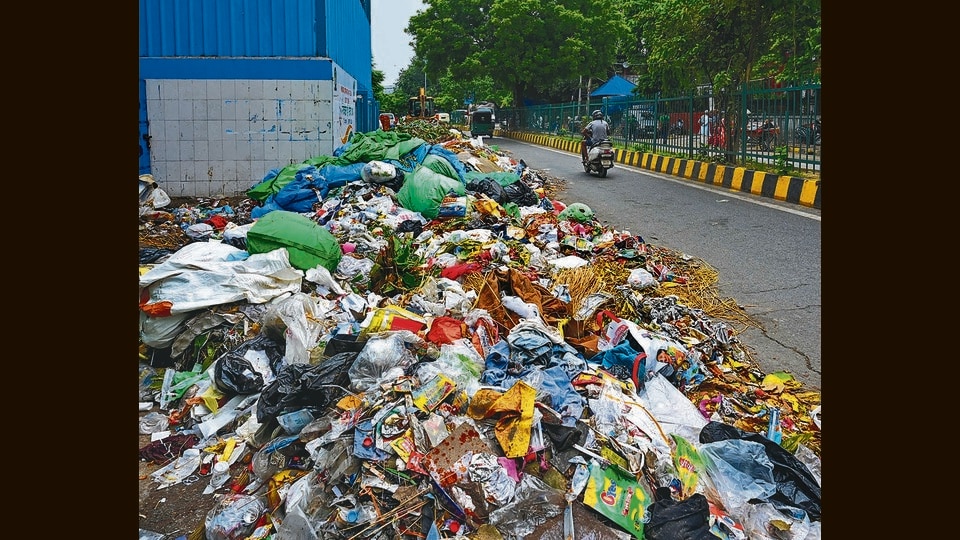
Even as the Delhi government celebrates “Delhi ko kude se azadi – Swachhta Abhiyan 2026” from August 17 to October 2, large parts of the Capital are drowning in garbage.
Dhalaos, the primary garbage enclosures within neighbourhoods, were originally intended as stop-gap collection points. But many have now become eyesores, with waste spilling on to streets, creating a stench and adding to traffic problems.
The situation is particularly visible in parts of south, central and west Delhi, including New Friends Colony, Deer Park, Katwaria Sarai, GT Road, Vedant Desika Marg and Church Road. In several locations, garbage is dumped openly (often spilling over in front of homes) and later pushed into trucks using excavators for transportation and disposal.
Also read: Gurugram claims fewer garbage hotspots, residents say dumps remain
Residents flag worsening garbage crisis
Atul Goel, who heads URJA, an umbrella body of resident welfare associations, said the city was increasingly resembling a garbage dump. “On the one hand we have been talking about dhalao-free city but filth is everywhere. There is no synchronisation between private concessionaires and waste generators. Corporation keeps talking about the transition phase of contracts but they knew the old contracts were expiring and they should have prepared in advance to bring and equip new companies,” he said.
The problems in large parts of south, central and west Delhi are linked to a bureaucratic and legal tangle surrounding the transition to new long-term contracts for waste collection and transportation.
Also read: Founder who paid ₹58 crore tax shares pic of garbage in Gurugram: ‘This is what our taxes fund’
Contract delays leave key zones struggling
Delhi generates more than 13,000 tonnes of waste every day, with collection in its 12 administrative zones outsourced to private companies. In the south, west and central zones, however, long-term contracts with previous operators have expired. The transition to new concessionaires has been delayed by administrative problems, re-tendering and, officials said, the prolonged political tussle over the constitution of the MCD Standing Committee.
An MCD report submitted to the Delhi government in April said the central and south zones each generated more than 1,050 tonnes of waste a day, while the west zone generated 1,308 tonnes. Together, the three zones cover 72 municipal wards and include areas such as Maharani Bagh, Friends Colony, Greater Kailash, Defence Colony and Panchsheel Park in south Delhi, and Janakpuri and Rajouri Garden in the west.
In the central zone, the original contract expired in 2022. Multiple extensions, reissued tenders and administrative delays followed, and the new contractor has still not fully taken over the work. As an interim arrangement, a contractor was given a six-month contract.
Also read: Sanitation strike turns confrontational across Haryana as police, workers clash
Short-term contract creates shortage
Officials said short-term contracts can themselves create problems because contractors are often reluctant to invest in equipment such as bins, auto-tippers and loaders for a tenure lasting only a few months. “For a short contract, a company cannot invest resources meant for 10 years. The company deployed for six months tends to work with a skeletal crew of excavators which leads to more visible garbage heaps,” an official said.
Under the long-term contracts, which are worth thousands of crores, private concessionaires are expected to provide vehicles, large bins, garbage compactors, transporters and manpower. Officials said much of that equipment has either not been deployed or is ageing in areas where old contracts have continued through extensions.
Also read: 250 vehicles to help tackle chronic garbage spots in Pune
“These are massive contracts and need years of preparation. Tenders were issued, they were recalled. Changes were made to conditions. There were also leadership changes leading to delay in awarding contracts. Then a phase came when the standing committee was not in place due to the AAP-BJP tussle,” a second official said.
The central zone, the official said, has faced the problem for around three-and-a-half years. The area was originally expected to be overseen by a company that went bankrupt.
The south zone has faced similar difficulties. Its contract expired around two years ago and the previous operator has continued on an extension, with old machinery. “Large parts of the city have basically been operating without enough resources like in the old times. Many of the bins and equipment have limited shelf life and hence operations are suffering,” the official said.
Also read: Delhi civic body plans complete overhaul of waste management system
New contractors begin phased takeover
Work orders worth around ₹2,939 crore were issued in March this year, with six months given to the new companies to begin taking over waste collection operations.
MCD commissioner Sanjeev Khirwar, while addressing the Standing Committee on Tuesday, said the new long-term contracts had been awarded for all three zones. “Ten wards in West zone have been taken up by the new company and there is improvement in waste collection in these areas. Our target is that by end of this month all 25 wards of West zone are covered,” he said.
For south and central Delhi, Khirwar said the MCD was holding regular meetings to ensure that new machinery and equipment were brought in by October 31. The transition could take another 10-15 days, he said. “Earlier these contracts used to take one-two years to negotiate, but we are trying to complete it in three months,” Khirwar said.
He said the east zone had contracts running until 2032 and the MCD was asking operators there to increase resources. Following insanitary conditions reported in Shahdara South, the civic body had asked the operator to deploy 45 additional auto-tippers, he said.
Khirwar identified north and northwest Delhi as areas where very old contracts were still causing problems. “We are trying to relook the contracts. A separate team is working on these,” he said.
Also read: West Bengal to levy fine over spitting, defecating, dumping waste: Govt
Mounds of waste disrupt daily life
Residents say the consequences of the delays have become increasingly difficult to ignore.
Shiv Mehra, president of the Maharani Bagh RWA, said the area had been struggling with overflowing dhalaos for nearly three years. “There are no bins so garbage is spread on ground and pushed using excavators. Besides being unsightly and stinking, it invites scavengers and now it is even becoming a traffic problem. Dhalao should be concealed but it is spread on all our roads,” he said.
Goel said residents should have a role in monitoring and certifying the work done by private concessionaires. “We have moved to solid waste management rules 2026 even as 2016 rules have not been implemented. Private operators have incentive to increase the garbage collection and it is a total planning failure for national capital,” he said.
For a city generating more than 13,000 tonnes of waste every day, the visible return of garbage heaps to neighbourhood streets is a reminder that replacing contractors is only one part of the problem. Unless door-to-door collection, source segregation and mechanised collection keep pace with the city’s waste generation, Delhi’s promise of a cleaner, garbage-free capital risks remaining on paper.
Frequently Asked Questions



Stay updated with all top Cities including, Bengaluru, Delhi, Mumbai and more across India. Stay informed on the latest happenings in World News along with Delhi Election 2025 and Delhi Election Result 2025 Live, New Delhi Election Result Live, Kalkaji Election Result Live at Hindustan Times.


