
 E-Paper



Pollution & politics: Why is clean air so hard to deliver?
Research suggests personalised information about pollution exposure can significantly increase voters’ political prioritisation of air quality.

 Prefer HTon Google


Air pollution is often treated as an environmental or public health problem. But it is also a deeply political one—shaped by what voters demand, what politicians believe voters will reward, which sources of pollution governments choose to target, and which institutions can compel action.
Grand Tamasha launches energy and climate series
Last week, Grand Tamasha—a weekly podcast on Indian politics and policy co-produced by HT and the Carnegie Endowment for International Peace—launched a new series on energy and climate issues in collaboration with the Center for the Advanced Study of India (CASI) at the University of Pennsylvania.
Over the next several months, the show will explore some of the most pressing energy and climate issues facing India—from the country’s green transition to the impact of climate on its coastlines, and its multilateral climate diplomacy. On last week’s episode, Vaishnavi Chandrashekhar and Tariq Thachil joined host Milan Vaishnav to discuss why toxic air has proven so politically challenging in India—and what it might take to change that.
Also read: Delhi braces for a warmer day as temperature rises, AQI shows improvement
Voters’ support for pollution policies varies by personal cost
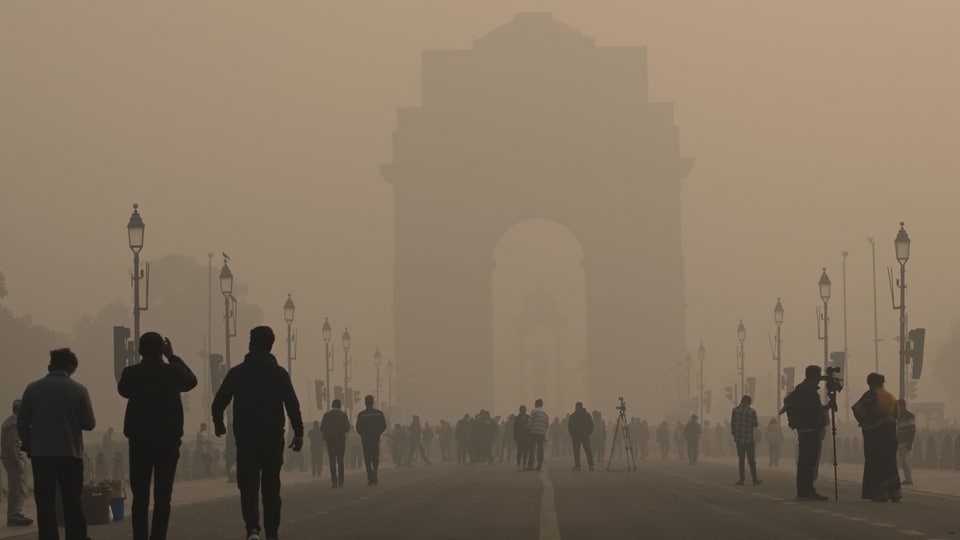
While media attention is often focused on Delhi, air pollution is a regional crisis that extends across South Asia, explained Chandrashekhar, an award-winning science and environment journalist based in Mumbai and a former Visiting Fellow at CASI. “One of the reasons is that the Indo-Gangetic Plain, which runs from Afghanistan in the west to Nepal in the east, is the most populated region in the world, so the economic activity is very high there. The region is also geographically peculiar because the Himalayas are to the north, and they form a wall that blocks the pollution from dispersing.” She noted that each year, the top 20 most polluted cities are dominated by metropolitan areas from India, Pakistan, and occasionally Bangladesh and Nepal.
While voters support action to combat air pollution in theory, they withdraw that support the moment the cost of those policies hit them personally, said Thachil, a Professor of Political Science at the University of Pennsylvania and the former director of CASI. “Nearly 83% of survey respondents supported a one-car limit on households, but most respondents in Delhi don’t own a car, so they wouldn’t be affected by this,” he explained. “By contrast, the vast majority opposed stricter pollution policies on bikes, and nearly two-thirds of the sample were in households that own a bike.”
Also read: Delhi records lowest September AQI in five years at 102, highest ‘moderate’ air quality days in 2026
Visible pollution shapes government priorities
Chandrashekhar noted that more “visible” causes of pollution attract disproportionate attention, often skewing government priorities. “Maybe ten years ago, there were 2 million private vehicles in Bombay, and now there are 5 million. Even though they follow [European] pollution standards, it’s not that they don’t pollute,” she argued. “They do pollute; you just can’t see it anymore. They’re not the sputtering diesel vehicles of old. It is less visible, but when you have 5 million of them, they’re polluting a lot.”
Also read: Delhi sees most polluted start to October since 2020, AQI deteriorates for 5th consecutive day
But there may be ways to make air pollution a greater political priority. Thachil said that his team’s research suggests that personalised information about pollution exposure can change how voters think about the issue. “We conducted an experiment in which enumerators told some respondents what their indoor Air Quality Index (AQI) was at the start of the survey, and we told others only at the very end after all the questions were asked,” he explained. “What we found is that telling voters their indoor AQI at the beginning raised their political prioritisation of air pollution quite significantly.”

Stay updated with all top Cities including, Bengaluru, Delhi, Mumbai and more across India. Stay informed on the latest happenings in World News along with Delhi Election 2025 and Delhi Election Result 2025 Live, New Delhi Election Result Live, Kalkaji Election Result Live at Hindustan Times.


