
 E-Paper



Inspections fade, tragedies repeat: Delhi's post-Hauz Rani fire drive fizzles out
Officials involved in Delhi's illegal building crackdown after Hauz Rani fire reveal operations lost steam after a month.

 Prefer HTon Google


The aftermath of every major building tragedy in Delhi by now appears to follow the same sequence of events: inspections, inquiries, lists of violations and promises of action. The latest collapse in Satya Niketan, which killed six people, has once again raised the question of what happens after that initial burst of action fades.
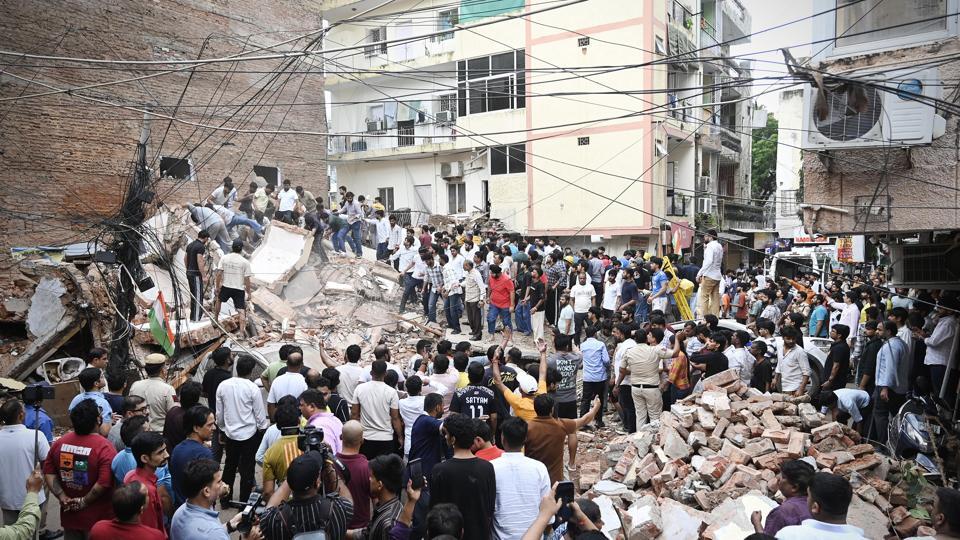
Sunday’s building collapse at south Delhi’s Satya Niketan comes barely three months after the Hauz Rani fire that killed 23 people. Back then, it had prompted the Delhi government to order a citywide enforcement drive against buildings and establishments violating fire-safety and construction norms.
But officials involved in that exercise said the inspections did not continue for long.
“There were directions issued to check buildings but later officials were asked to only ensure no new construction is taking place. There were also instructions given on identifying ground-plus-four (G+4) structures. Different directions were issued at different times and following the initial push, inspections were stopped after it was felt that the vulnerable areas have been covered,” said an official familiar with the exercise, requesting anonymity.
Another official said the biggest problem with exercises such as these is the limited powers of the teams carrying out the inspections.“Their job was to identify violations, inform the MCD for taking appropriate action,” he said, adding that the sub-divisional magistrates conducting the inspections were not authorised to seal buildings.
Gov action after Hauz Rani fire died down
The government had constituted 13 district-level committees following the Hauz Rani fire, with district magistrates heading teams comprising officials from the administration, police, Municipal Corporation of Delhi (MCD) and fire service. They were tasked with surveying illegal and unauthorised buildings, with particular attention to commercial establishments, G+5 structures and buildings operating without fire-safety certificates.
Sub-division committees were expected to support the inspections and submit daily reports, while district administrations were to provide weekly updates to senior officials. The exercise covered hotels, guest houses, nursing homes, coaching centres, restaurants and other establishments considered vulnerable.
Yet, officials said the drive gradually “wound down” after finding faults and violations. Officials said that the action that should generally follow such enquiries and crackdowns is an actual enforcement drive which leads to sealing of locations violating norms or for action against those who have allowed and profited off of those illegalities. “But cracking down on illegal activities on such a large scale requires the kind of action that will upend the workings of far too many officials, governments and people,” said one of the officials cited above.
That is what makes the apparent winding down of the latest inspection exercise significant. Officials and experts said that a post-disaster inspection can identify hundreds of violations, but unless those findings feed into a permanent system of monitoring and enforcement, buildings can once again slip through the cracks.
Also Read I Satya Niketan building collapse: Student, teacher bodies call for accountability
Inspections and warning prevail without action
Take for instance the two magisterial inquiries ordered after major Delhi tragedies this year. Both have already documented how warnings, complaints and inspections can fail to translate into sustained enforcement.
The inquiry into the June 3 Hauz Rani fire found failures across several agencies, including the MCD, Delhi Police, the tourism department and local power distributor.
It found that the illegally expanded building had continued to operate as a bed-and-breakfast despite repeated warnings and serious discrepancies in its licensing and inspections. The tourism department’s inspection committee was accused of overlooking glaring irregularities, while the building did not have a mandatory fire NOC. The inquiry called for clearer assignment of responsibilities among agencies regulating commercial establishments and action against officials found responsible for lapses.
The recommendations came despite the fact that the Hauz Rani facility had been inspected twice before its licence was cleared. Five officials subsequently faced action in the MCD’s preliminary probe.
Barely days before that fire, another tragedy had exposed a similar failure.
Building collapse in Saidulajab
On May 30, six people were killed when an unauthorised building in South Delhi’s Saidulajab collapsed. A subsequent magisterial inquiry concluded that the disaster was preventable and found serious lapses by the MCD.
The inquiry alleged that civic officials had failed to monitor and crack down on illegal construction, ignored multiple complaints and failed to enforce building norms. It also found that retrospective inspection records had been fabricated to mislead investigators. Most significantly, the building had already been “booked” by the MCD for violations, but meaningful enforcement action did not follow.
Also Read I SOS video from under debris: Student trapped in collapsed Delhi boys’ PG building reaches out to friend
The findings from the two inquiries, however, point to a problem deeper than the absence of information. In both cases, authorities had either received complaints, conducted inspections or had knowledge of violations. The failure was in converting that knowledge into effective and sustained enforcement.
In Hauz Rani, repeated warnings did not stop an illegally expanded establishment from operating. In Saidulajab, the MCD had reportedly already identified the building as being in violation, but in both instances, the action stopped there.


Stay updated with all top Cities including, Bengaluru, Delhi, Mumbai and more across India. Stay informed on the latest happenings in World News along with Delhi Election 2025 and Delhi Election Result 2025 Live, New Delhi Election Result Live, Kalkaji Election Result Live at Hindustan Times.


