
 E-Paper



GSLV-F17 rocket successfully places heaviest earth observation satellite into intended orbit: ISRO
After a flight journey of about 19 minutes, the satellite got separated from the launch vehicle and was successfully placed in the sub-geosynchronous orbit.

 Prefer HTon Google


CHENNAI: A GSLV-F17 rocket on Friday successfully placed the heaviest Earth observation satellite EOS-05 in the geosynchronous orbit, marking a great achievement in the country's space programme, Indian Space Research Organisation (ISRO) Chairman V Narayanan said on Friday.
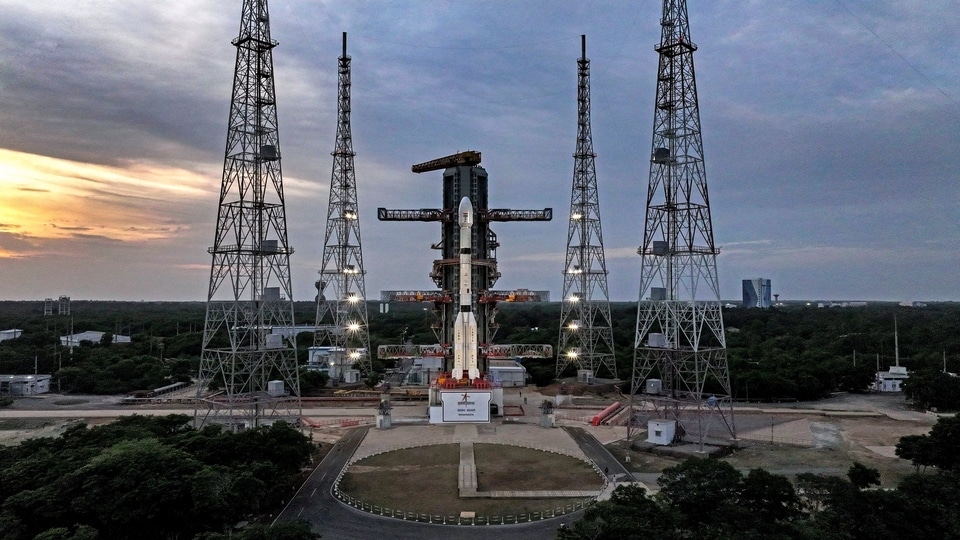
In a precise textbook launch, after the conclusion of the 27.5 hour countdown, the 51.7 metre tall rocket, lifted off majestically emanating bright orange colour fumes on its tail from the second launch pad at the Satish Dhawan Space Centre, Sriharikota at a pre-fixed time of 2.55 am at the spaceport, located about 135 km east of Chennai on Friday.
After a flight journey of about 19 minutes (from the lift-off), the satellite got separated from the launch vehicle and was successfully placed in the sub-geosynchronous orbit by the GSLV rocket into the intended orbit.
Deep Dive

The satellite is dubbed to be 'eye in the sky' for its ability to monitor the Earth from an altitude of about 36,000 km and share images of the Earth every 30 minutes, ISRO said.
Making his address at the Mission Control Centre, ISRO Chairman V Narayanan said, "I am very happy to announce that the GSLV F-17 vehicle has successfully and precisely injected the advanced earth observation satellite (EOS-05) the geo-imaging satellite in the intended and required orbit."
He further said, "This is 107th launch from Sriharikota and the 19th mission of the GSLV. As you all are aware , the first launch of GSLV was done with a payload of 1,536 kg from that gradually we have improved the performance of this vehicle by optimising the structural mass, improving the propulsion systems and today, we have injected the heaviest satellite 2,367 kg satellite using this launch vehicle."
Noting that the satellite would be operationalised in the coming days, he said, "it will become India's first dedicated imaging satellite from the geo-synchronous orbit providing important strategic data for our country."
"The solar panel is deployed, the health of the satellite is perfectly alright.", he said.
Narayanan, also the secretary, department of space, said, "in the coming days, we will raise the orbit and take it to the required orbit and place the satellite in the geo-platform".
"Friends, you all will agree with me, this success is a culmination of team work of entire ISRO, along with the industrial partners, and academia which has provided a lot of support also this success is because of work culture and vibrant review mechanism of ISRO.", he said.
"This is a great achievement in our country's space programme. Because this is the first earth observation satellite which is going to be placed in the geo platform for the national activities.", he said.
The GSLV which has a lift off mass of 420.5 tonne is a three-stage vehicle with a cryogenic upper stage.
The GSLV rocket equipped with a 4-metre-diameter ogive composite payload fairing and placed the satellite, weighing 2,367 kg, at an altitude of 31,000 km, Narayanan said.
At this height, the satellite’s orbit synchronises with the rotation of the Earth, ensuring it stays at a fixed place. The satellite would provide repeated images of India and neighbouring regions.
The Geosynchronous Satellite Launch Vehicle with a cryogenic upper stage is intended to carry heavier satellites weighing 2,200 kg to be placed into Geosynchronous Transfer Orbits (GTOs).
The mission objective is to provide real-time imaging of large-area regions at frequent intervals for quick monitoring of natural disasters and episodic events, and to obtain spectral signatures for agriculture, forestry and waterbodies, ISRO said.
The Earth Observation Satellite would also share information for disaster warning, cyclone monitoring, cloudburst and thunderstorm monitoring, ISRO said.
Today's mission is the follow-up to the GSLV-F10/Earth Observation Satellite-03 which was 'unsuccessful' as it suffered a cryogenic upper stage ignition failure after lift-off on August 12, 2021 at 5.43 am from Sriharikota.
The previous GSLV mission launched by ISRO was GSLV-F16/NISAR on July 30, 2025. It is the first-of-its-kind mission jointly developed by ISRO and NASA to image global land and ice-covered surfaces, including islands, sea ice and selected oceans, every 12 days.
On the future launches, Narayanan said, "ISRO has planned to launch six more missions within this financial year which includes launch of navigation satellite (from Sriharikota)."
Union minister of State for science and technology Jitendra Singh says, "Another giant leap for India in Space!
Kudos to Team @isro on the successful launch of GSLV-F17/EOS-05.
EOS-05 is a state-of-the-art Earth Observation satellite and India’s first imaging satellite from Geosynchronous Orbit, enabling advanced imaging across visible, infrared, multi-spectral and hyperspectral bands.
With the visionary leadership of PM Shri @narendramodi Ji, India’s space capabilities continue to scale new heights, strengthening our position as a global space power."


