
 E-Paper



The blue wave was powered by moderate Democrats
Our analysis shows progressives had mostly easy wins


 Prefer HTon Google


“IF ABDUL CAN win in Michigan, anybody can win anywhere,” Alexandria Ocasio-Cortez proclaimed last month, in comments leaked to the New York Times. The progressive congresswoman’s hopes came true this week when Abdul El-Sayed, a strident left-winger, won the state’s Senate race. But he had scarcely finished his victory speech when centrist Democrats raced to pooh-pooh the result, noting that his seven-point margin of victory in a state that has not elected a Republican senator since 1994 looked underwhelming amid a historic blue wave.
As Democrats turn their focus to the presidential primaries of 2028, a single Senate race does not provide enough evidence to give the upper hand to either side of the party’s ideological divide. Fortunately, there were 469 other Congressional elections that also contribute to the debate. And the broader picture suggests that the moderates, at least moderately, have the better side of the argument.
The hardest part of measuring the electoral impact of ideology is figuring out who belongs to each camp. Incumbent legislators’ voting records do not reveal whether lawmakers who bucked Democratic leadership did so from the left or the centre. Even less data is available for non-incumbents. And there is no single definition of progressive versus moderate: most elected Democrats share Dr El-Sayed’s views on the vast majority of issues. He stands out mainly for his criticisms of Israel and his own party’s leadership.
To avoid being influenced by the election’s results, before any votes were tallied we compiled a list of 32 candidates who were both left-wing and opposed the Democratic “establishment”. Anyone who had belonged to or was endorsed by the Democratic Socialists of America (DSA) for any office qualified, as did anyone endorsed by Justice Democrats. We also counted candidates endorsed by Our Revolution, a progressive group, so long as they also had proven anti-establishment credentials by challenging an incumbent in a primary, calling for party non-intervention in primaries or calling for new Democratic leadership in the Senate. For moderates we used endorsements from or membership in the Blue Dog Coalition and PAC, a longstanding group of centrist Democrats, and membership in the Problem Solvers Caucus, a bipartisan group of moderates.
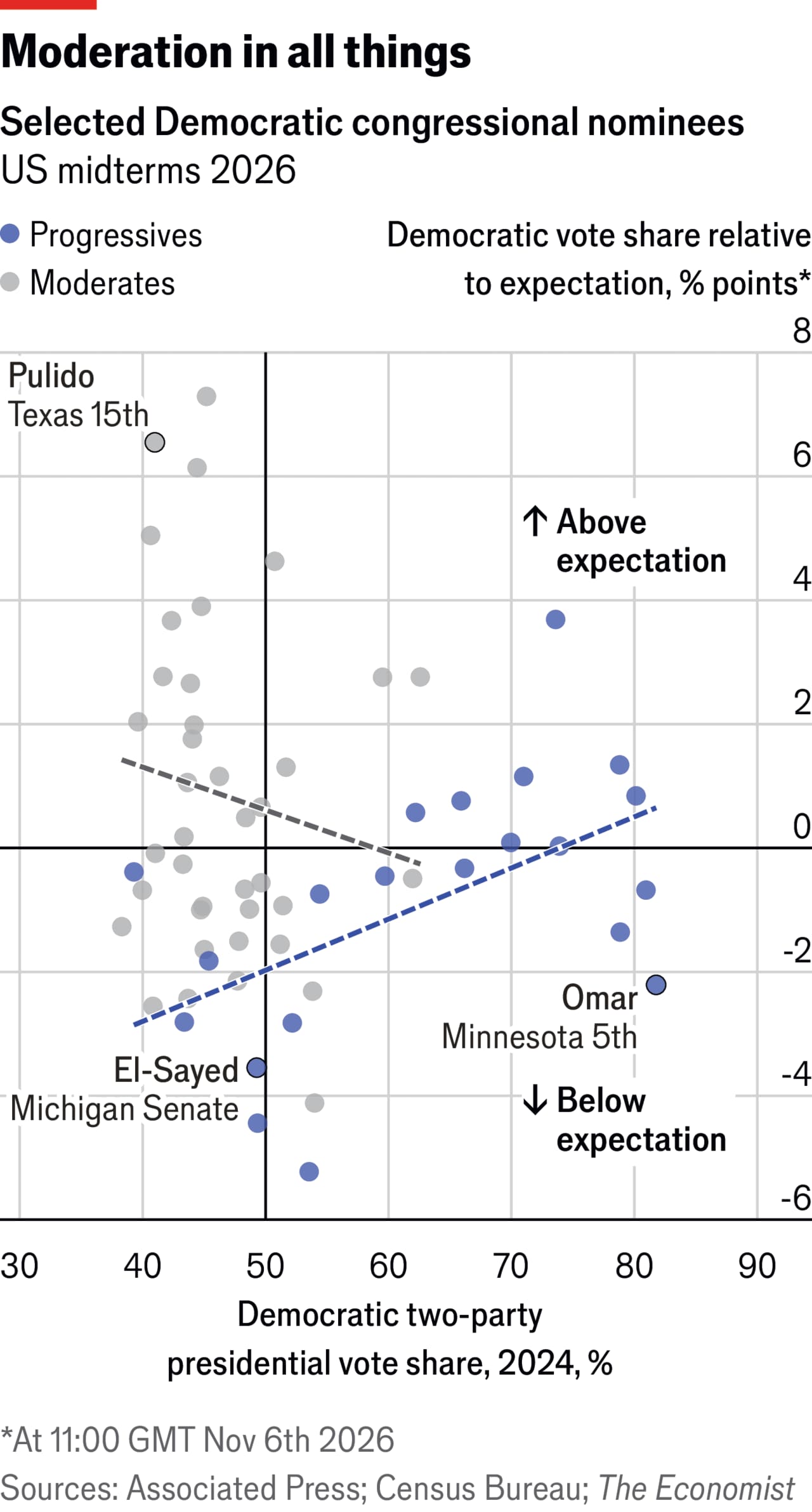
Electoral performance is also tricky to measure, since even weak candidates can prevail when there is a blue wave across the country, or when they run in solidly left-wing areas. To account for such context, we built a statistical model to predict the result in each of the 358 contested House districts where at least 80% of the vote has been counted. It uses voting histories, incumbency, demography and economic factors to estimate how any generic Democrat should have performed in each race. We then measured each candidate against that benchmark.
As a group, the 39 moderates in qualifying races beat their benchmarks by just under one percentage point of vote share. The 21 progressives fell short by a similar amount. However, these effects varied by geography: the penalty for progressivism was greatest in redder areas. All eight lefties in our analysis who ran in places where Kamala Harris won less than 55% of the vote finished short of their benchmarks, by an average of 2.7 percentage points. That may sound modest, but subtracting it from the winner’s vote share in every state would have changed the outcome in six of the past seven presidential elections. For moderates, the trend was reversed: their overperformance was concentrated in Republican-voting areas.
Progressives will surely pick holes in this trend. The biggest drag on the group’s showing was Troy Jackson, who entered Maine’s Senate race only in July after a scandal drove out the previous Democratic nominee. He accomplished the herculean task of unseating Susan Collins, the strongest electoral outperformer in the entire Senate, and would probably have fared at least five points of vote share better against a standard Republican. Similarly, Angie Nixon, the surprise winner of Florida’s Senate primary, came within three points of victory even though the national Democratic Party spent nothing on her race.
Nonetheless, it stands to reason that candidates fare best if their views are a good fit for their states or districts. And given that presidential elections are typically decided in states near America’s ideological median, a Blue Dog-style nominee would probably stand a better chance of winning back the White House than a DSA-backed one.


