
 E-Paper



Lok Sabha elections 2019: In Bengal’s former Red stronghold, a saffron surge
The BJP sees its best chance to storm the Trinamool citadel, riding on tribal discontent, festering corruption allegations and resentment over shrinking employment.

 Prefer HTon Google


In his first year at the Silda Chandra Sekhar College in West Bengal’s Jhargram, Rajesh Mondal was drawn to local politics. He was 20, and local activists were organising against what they saw as oppressive policies and neglect of the region by the then Left Front government.
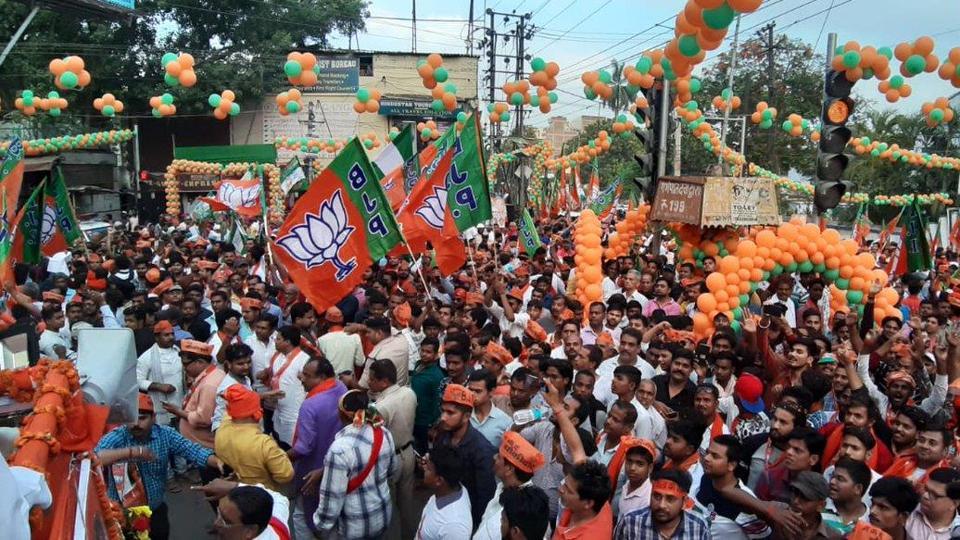
A few years later as the Trinamool Congress rose as the principal challenger to the Left, he joined the fledgling regional party and remained with it over the following decade. In this time, his village of Harda saw its first pucca road, a bus service, mobile phone towers and electricity.
But two years ago, Mondal quit the Trinamool Congress and joined the Bharatiya Janata Party (BJP). His decision surprised many — after all, no one had heard of the party in his village, and there was hardly any local leader from the BJP that the villagers knew. And, in the Bengal countryside, where the “party” is the final word on things ranging from ration and jobs to children’s school admission, what benefit could the BJP possibly promise?
“No one had even seen a saffron flag in our village till then. But we slowly changed all that,” says the 41-year-old.
The gradual change snowballed into a surge last year during the village and urban local body elections, crucial in a primarily rural state, where the BJP surged to surprise victories in many panchayats in the area. In Harda, for example, the Trinamool Congress couldn’t win in any of the 17 seats, and Mondal’s wife Jhuma is now the panchayat chief on a BJP symbol. “We are telling everyone about Modiji. Earlier, the BJP campaign would end in the big cities, but we have brought it into our gallis,” Mondal says.
There are others like him. Bablu Murmu is campaigning for eight hours daily in the erstwhile Maoist bastion of Lalgarh, Sunil Murmu trekked two hours to Ghatal to hear BJP chief Amit Shah last week, and Jhuma De is tired of giving a cut to the local ‘dada’. Together, they are the reason the BJP sees its best chance to storm the Trinamool citadel, riding on tribal discontent, festering corruption allegations and resentment over shrinking employment.
THE CHALLENGE
The western districts of Purulia, Pashchim Medinipur, Bankura and Jhargram are among the most underdeveloped in the state (and the country), with few industries, cities, or avenues of employment. Loosely, they are also called Jangal Mahal, a British-era reference to the thick canopy of forests that forms the backbone of tribal sustenance, and red insurgence.
Till about a decade ago, the area was overrun by Maoists who established a parallel local administration in Lalgarh in 2008 after police brutality angered the local tribal population. When Banerjee swept to power in 2011, one of her central poll promises was to “bring smiles to the face of Jangal Mahal”.
She quickly set up a separate department, went after the Maoist leaders aggressively and built roads and gave electricity connections. Her party stormed the Left bastion in the 2014 general elections, and won handsomely in assembly elections two years later.
“There was development, look at the smooth roads. But development creates aspirations, which the government couldn’t fulfil. After getting rice and an allowance, a family wants a job for their children. Without industry, where are the jobs,” asked Kumaresh Ghosh, a former professor at Midnapore College.
The Rashtriya Swayamsevak Sangh (RSS) and its affiliates, the Vishwa Hindu Parishad and the Bajrang Dal, have expanded their presence in the area – not only through the well-publicised rallies on Ram Navami but through the network of Vanavasi Kalyan Ashram schools. “Many Left leaders have joined us, because the party has no strength left. But it is true that when we campaign, issues of jobs and corruption are more important than Ram and Hindutva,” says Sukhamay Satpathy, Jhargram district BJP chief.
THE INCUMBENT
The Trinamool Congress is aware of the challenge and has deployed a three-pronged strategy.
The first is deploying heavyweight candidates. In Bankura, Banerjee has nominated state minister Subrata Mukherjee to replace unpopular Moon Moon Sen. In Medinipur, Manas Bhunia has resigned his Rajya Sabha membership to fight state BJP chief Dilip Ghosh. And in Jhargram, the party has picked Birbaha Soren, wife of influential tribal leader Rabin Tudu (though the move has somewhat backfired after Tudu was expelled from the tribal council).
The second is leaning on organisation and welfare schemes. The Trinamool is confident that no party can match its booth-level presence. The party is also hoping for a split in the opposition votes in three or four-way contests.
And, the third is Banerjee, who is addressing roughly two meetings a day, often in obscure hamlets. In a meeting in Belpahari last week, she admitted that some in her party may be corrupt. “But you know me, don’t desert me,” she told the audience.
According to Trinamool leader Subhendu Adhikari, Banerjee gave the region everything. “You can see Didi’s development, you cannot see Modi’s development,” he said. This battle between organisation and sentiment, personal appeal and grassroots corruption will shape the battle in Jangal Mahal.


