E-Paper



Central leadership fixed land, power issues in Delhi, says BJP
Dubbed as the ‘Thank You Modiji rally’, the public gathering at Mukundpur Chowk in Burari in northeast Delhi was addressed by top state BJP leaders

 Prefer HTon Google


Leaders of the Delhi Bharatiya Janata Party (BJP) on Sunday said that due to the party’s central leadership, the problems arising out of the halt on land mutations and issuing of power no-objection certificates in unauthorised colonies have been solved, even as it blamed the ruling Aam Aadmi Party (AAP) for stopping the works.
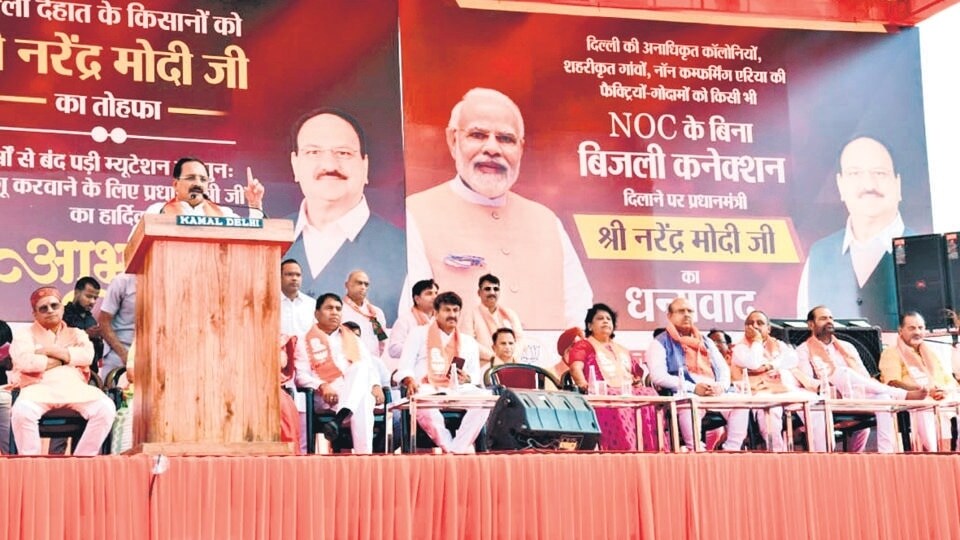
At a public gathering in Burari as part of its outreach programme ahead of the assembly elections, Delhi BJP chief Virendra Sachdeva said that the intervention by the party has benefitted several thousands of residents.
He also slammed the AAP and its chief Arvind Kejriwal, alleging widespread corruption during 10 years of the party’s rule in Delhi.
The AAP in response said that the BJP was misguiding people, and challenged the opposition party of making the supply of electricity free in the states it is in power in.
Dubbed as the ‘Thank You Modiji rally’, the public gathering at Mukundpur Chowk in Burari in northeast Delhi was addressed by top state BJP leaders, including MPs Manoj Tiwari, Ramvir Singh Bidhuri, Yogendra Chandolia, Praveen Khandelwal and Bansuri Swaraj.
Read more: Kejriwal touts Delhi's 'revri' , dares PM to provide free electricity in NDA-ruled states
Ahead of the upcoming assembly elections likely to be held early next year, the Delhi unit of the BJP has been holdingweekly outreach programmes in JJ clusters, slums and resettlement colonies every Sunday since August 5.
At Sunday’s rally, the BJP leaders said when it comes to power in Delhi, the first cabinet meeting will take decisions on electricity and water subsidies to benefit the common people. Besides, the PM Housing Scheme and the Ayushman scheme would also be implemented and all temporary staff, home guards, bus marshals, and guest teachers would be regularised, they said.
“I want to thank Prime Minister (Narendra ) Modi because with his blessings, the Delhi BJP has become successful in solving two problems of unauthorised colonies. Due to mutation hurdles, elders in villages of Delhi were not able to give their properties to their children. The government of Arvind Kejriwal was not letting it happen. The restriction of mutation has been withdrawn. The Delhi Development Authority’s (DDA) NOC used to be sought for electricity connection in unauthorised colonies. This was AAP’s ploy to force people to buy electricity at ₹20-25 per unit, but this compulsion has also been removed,” Sachdeva claimed.
The lieutenant governor (LG) VK Saxena-headed DDA on October 1 allowed city discoms to approve new electricity connections in urbanised villages, colonies regularised by MCD, and godowns, factories in non -conforming industrial areas, without seeking an NOC. Prior to that, on September 17, Saxena had also directed to resume the mutation of land property in villages, thereby allowing residents of urban villages to record ownership rights of their agricultural land based on inheritance.
According to the BJP, around 330,000 people are expected to benefit from the relaxation granted in the process to install electricity meters in illegal and unauthorised colonies.
New Delhi MP Swaraj said that the mutation of land had been stalled since 2010 but has now been restarted. “The people in rural areas of Delhi will now find it easier to mutate their ancestral land,” she said.
North East Delhi MP Tiwari said that people have faced immense hardships due to lack of NOCs for electricity meters. “There have been cases where people did not have a meter in their house for six years. One meter has 200 connections. People were being charged ₹15 per unit. This has been going on for the past six years, and the AAP government is also involved,” he alleged.
Chandolia said that the Delhi government has betrayed the villages of Delhi.
“To resume the stalled mutations, all seven MPs pleaded before the LG, after which the home minister resolved this issue. We have gathered here to express our gratitude to PM (Modi). Private electricity companies have been colluding with the AAP government to loot the people of Delhi. Complaints about harassment in the name of electricity meters and NOCs have been repeatedly raised,” the MP added.
In response, the AAP said that the Delhi government provides the cheapest electricity in the entire country. “The BJP is taking credit for work done by the AAP. If the BJP is so concerned about the people, why don’t any of the 22 BJP-ruled states offer free electricity? The BJP people are trying to misguide Delhiites...in the BJP-ruled neighbouring state of Uttar Pradesh, the price of electricity connection has been increased by 250%.”