
 E-Paper



Private equity firms will destroy the healthcare system: Dr P Jagannath
The 70-year-old surgeon has operated on more than 8,500 cancer patients and pioneered HPB surgery and advanced rectal cancer preservation techniques in India.

 Prefer HTon Google


Dr P Jagannath is no stranger to praise for his hands. The 70-year-old onco (cancer) surgeon, who started his career at the Parel-based Tata Memorial Hospital in 1982, has for years heard versions of “Doctor Saab, aapke haath mein jadu hai (you have magic in your hands)” or “your hands have divine power” from the patients he has operated upon and their kin.
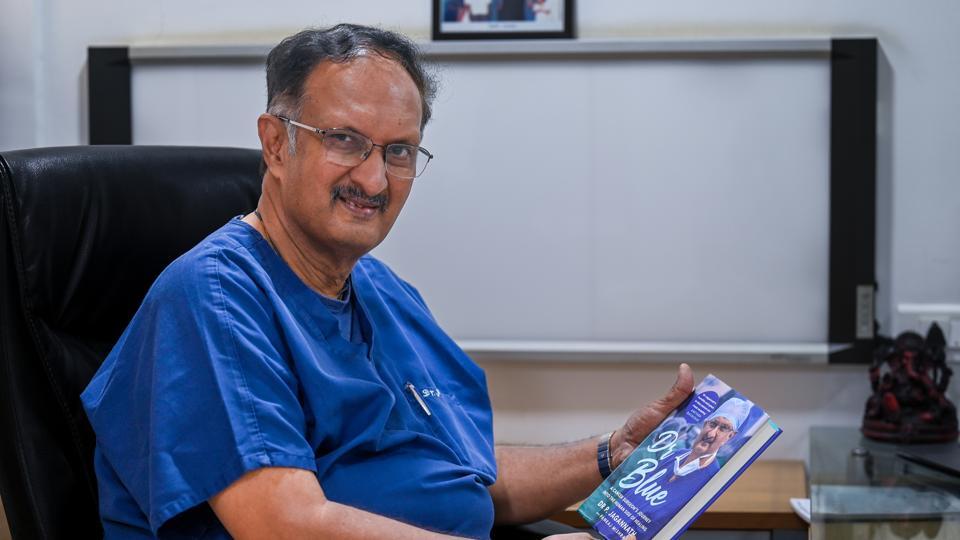
“People say it with gratitude, with relief, sometimes with the kind of wonder that belongs to temples and not to operating rooms. And every time, almost instinctively, I reply the same way, ‘No power. These are just normal hands’”, writes Jagannath in chapter 15 -- ‘My Hands, My Touch’ -- in his memoir ‘Dr Blue: A Cancer Surgeon’s Journey Into The Human Side of Healing’, co-authored by writer Pankaj Mishra.
Fondly called Dr Blue - Dr Jagannath credits lyricist and filmmaker Gulzar for the moniker - that is symbolic of the colour of the scrubs he dons both outside and inside the operation theatre, the 275-page book was launched on Friday by Amitabh Bachchan, Gulzar and Sachin Tendulkar, at a Juhu 5-star hotel.
Also read: Review: Memoirs by Mannu Bhandari and Rajendra Yadav
From Tata Memorial Hospital to a four-decade career
The book, which traces his journey as a bright student in Kurnool, Andhra Pradesh, to his karmabhoomi Mumbai, touches upon several stories of cancer patients from VIPs/ politicians, industry leaders, affluent and poor during four decades of Dr Jagannath’s professional life. “Cancer and war are equalisers,” he says.
Having successfully operated on more than 8,500 cancer patients, the purpose of the book is to bring out success stories, says Dr Jagannath, who is a consultant in the surgical oncology department at SL Raheja Hospital – A Fortis Associate, Mumbai. He also currently serves as the chairman of surgical oncology at Lilavati Hospital & Research Centre, Bandra.
“Cancer is a disease which is largely approached with a lot of negativity and fear. But at the same time, it is important to convey positivity and the will power of the people who have actually fought the disease and won. When I look back, I find a lot of stories of motivation or strong resilience among cancer patients. Success stories are important to be told. It’s also been very uplifting for me,” he said, seated in his consulting room at S L Raheja Hospital.
On a wall are photo frames of him alongside eminent personalities such as Bachchan, Tendulkar, former prime minister Rajiv Gandhi, industrialist Ratan Tata and Nobel Laureate and human rights activist Archbishop Desmond Tutu on various platforms.
Also read: New 'smart cancer drug' designed to 'switch on' may replace chemotherapy, says govt
Many twists and turns
Dr Jagannath’s run-up to his professional life is one of many twists and turns - from landing in Mumbai to bagging a job in TMH and settling in on onco-surgery after trying his hands at cardiac and plastic surgery.
Within cancer surgery, he is recognised as a pioneer of both Hepato-Pancreato-Biliary (HPB) surgery that he brought to India in 1985 and advanced rectal cancer preservation techniques. He is also known to have successfully completed the country’s maximum number of pancreatic resections - also called Whipple’s operations.
In 2000, Dr Jagannath established Crusade Against Cancer Foundation, which is a charitable trust that provides financial assistance to cancer-afflicted patients, particularly children, and supports cancer awareness and education. All the proceeds from his book will go to the Foundation.
Also read: The next chapter of health care will be driven by technology
Memoir highlights resilience among cancer patients
Away from his experiences, achievements and accounts of strong-willed patients, there’s another dimension of health that Dr Jagannath has reflected upon in his book - the changing face of healthcare.
The book delves into the use of technology such as artificial intelligence (AI) and robotic surgery in healthcare.
AI seen as a tool to decentralise cancer care
For him, AI stands for Assisted Intelligence. “We use models like ChatGPT, Claude and NotebookLM extensively. Based on patient reports that are sent to us on WhatsApp, my juniors quickly get a summary using these models. I get information and insights much faster which helps increase my productivity. It leaves me with more consultation time with my patients,” says Dr Jagannath.
“AI used in this manner can prevent 60% of cancer patients from coming all the way to Mumbai since we can then empower local physicians and surgeons in respective cities or districts with treatment protocols.”
Also read: Using AI to monitor your heart health? Cardiologist reveals how much you can rely on it
While technology can be an enabler in decentralising cancer care, Dr Jagannath is vocal about his concerns on the mushrooming of medical colleges without adequate facilities and quality teachers, and the privatisation of healthcare.
On the increasing number of private equity firms entering the sector, he warns, “Unlike charitable hospitals that were set up with corpus from family trusts, private equity firms will destroy the healthcare system, with the cost of treatment becoming very expensive. Healthcare, and in turn doctor-patient relationship, will become a business and not a service.”

Stay updated with all the Breaking News and Latest News from Mumbai. Click here for comprehensive coverage of top Cities including Bengaluru, Delhi, Hyderabad, and more across India along with Stay informed on the latest happenings in World News.


