
 E-Paper



How Delhi’s AI signals on 42 corridors will fare: What traffic police simulation says
The Integrated Traffic Management System will be rolled out across 42 corridors in three phases over 24 months.

 Prefer HTon Google


An AI-backed traffic management system, which is expected to be implemented by Delhi Police in three phases over 24 months, may offer modest relief to commuters on some of Delhi’s busy corridors but simulation data suggests that the city’s most heavily clogged arterial roads are likely to get only incremental gains.
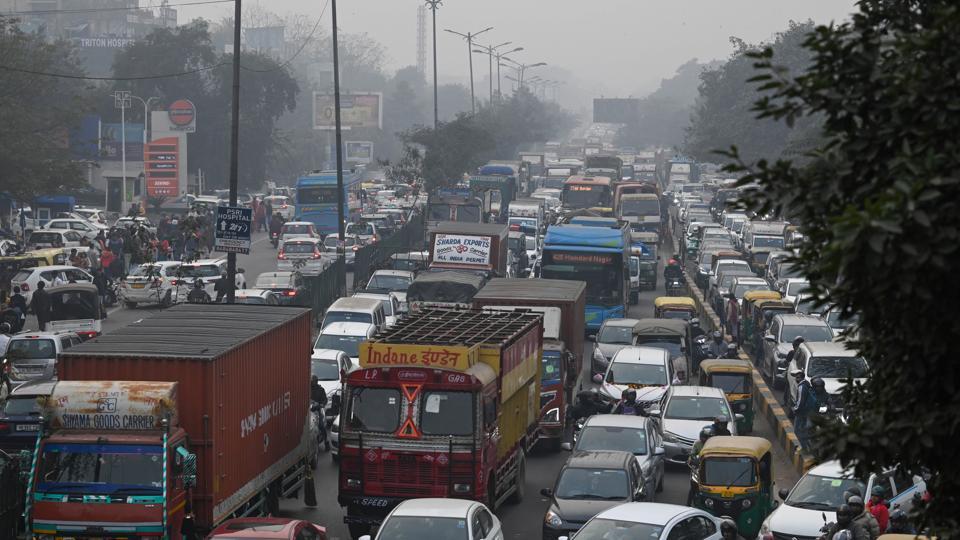
HT has accessed the list of 42 corridors where the Integrated Traffic Management System (ITMS) will first be implemented, and a simulation study by the Delhi Traffic Police on these stretches.
The simulation suggested that on the 48-kilometre-long Ring Road, the reduction in delay times and travel times would be only 10%. Meanwhile on the 26.5km Outer Ring Road delays were estimated to drop by around 30% and travel time by over 20%.
Delay time refers to time spent in traffic, while travel time is the duration of the entire journey.
HT has repeatedly reported that both the Ring Road and Outer Ring Road remain perpetually congested, struggling under the weight of high vehicular density, persistent lane friction, and frequent vehicle breakdowns.
Also read: Security tightened for Dussehra in Delhi-NCR, crowd management and traffic plan in place
Projected gains vary across corridors
The study estimated that some stretches could fare better. According to it, Nelson Mandela Road, the DND Flyway–Ghazipur Road corridor, Mayapuri Road, Payal Road, and National Highway 9 (NH-24) could see delays reducing by around 40% and travel times by over 25%.
An officer familiar with the assessment cautioned that the figures were projections rather than measured improvements. “These metrics are simulation-based estimates derived from computer modelling, and do not represent ground-level reductions achieved so far,” the officer said, declining to share details of the study’s methodology.
The officer did not share how the study was conducted.
“This is what we are expecting, but we will have to see when it’s really rolled out,” a second senior officer said.
A detailed analysis of all 42 corridors in the study showed an uneven impact across the Capital.
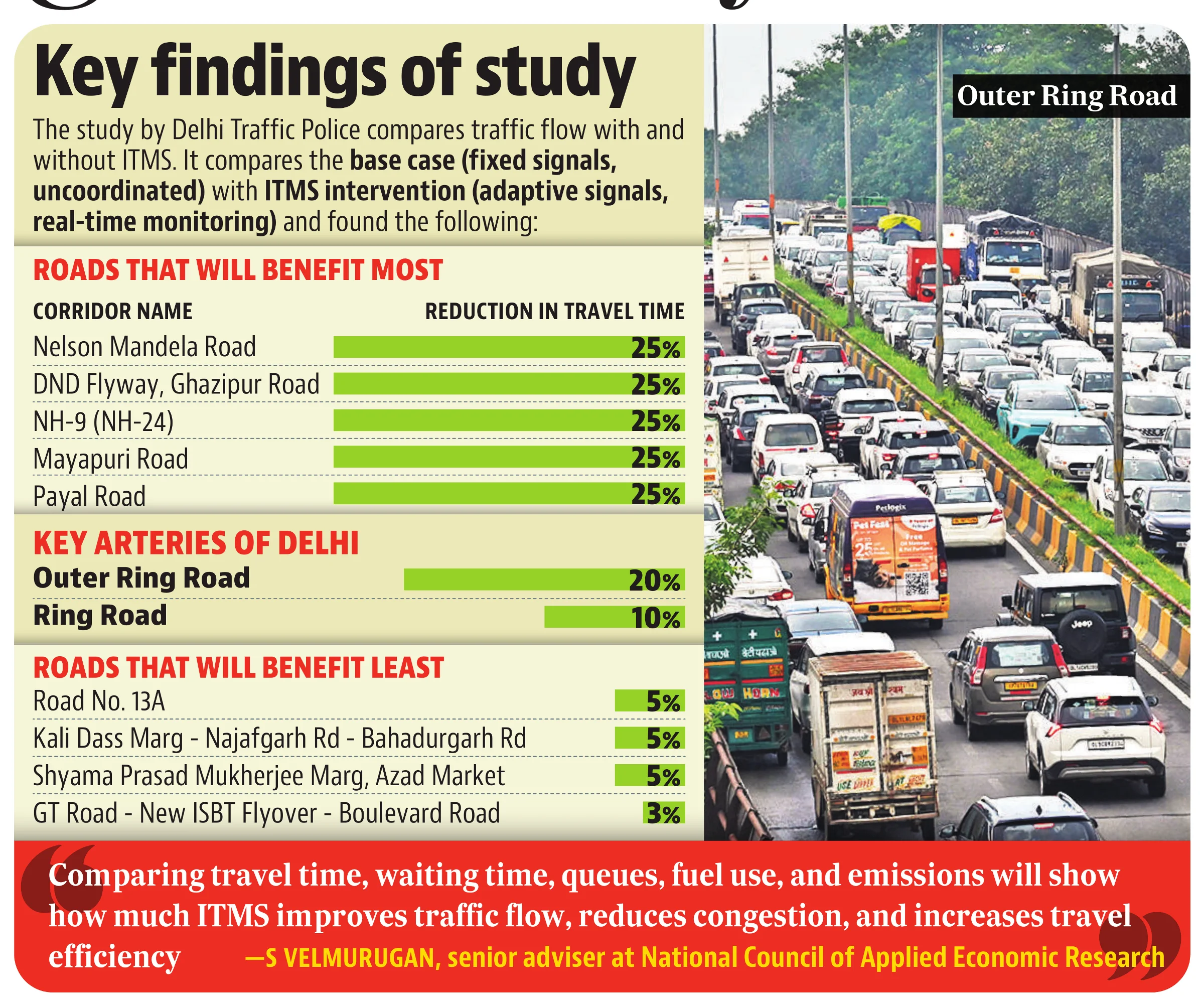
While secondary connectors and localised stretches -- such as Lodhi Road, Press Enclave Road, Lala Lajpat Rai Marg–Lal Bahadur Shastri Marg, and the Rao Tula Ram Road–Shantipath stretch — were projected to see delays drop by around 30% and travel times by over 20%, major high-volume transit routes struggled to show comparable gains.
Corridors with heavily saturated intersections and complex multidirectional flow fared considerably worse. The 21.07-km stretch covering GT Road, New ISBT Flyover, Boulevard Road, and GT Karnal Road, for instance, was estimated to see a negligible reduction of 2% in delay and travel times. Similarly, the 23.79km arterial stretch spanning Kali Dass Marg, Moti Nagar Flyover, Najafgarh Road, and Bahadurgarh Road, as well as Shyama Prasad Mukherjee Marg near Azad Market, showed a meagre 5% reduction in delays.
Other critical routes — including the 20.28-km Mehrauli-Gurgaon Road and the Sri Aurobindo Marg stretch, the 20.48-km Mathura Road–BSZ Marg corridor, and the 20.35-km NH48–Sardar Patel Road – Connaught Place connection — were projected to achieve only about 10% relief in delays and travel times.
How the simulation assesses traffic changes
S Velmurugan, senior adviser at the National Council of Applied Economic Research and former chief scientist at the Central Road Research Institute (CRRI), said simulation studies typically compare traffic conditions with and without the proposed intervention to estimate its likely impact. “The first will be the base case, which will simulate traffic conditions without ITMS, taking into account existing fixed-time traffic signals, uncoordinated intersections and normal driver behaviour. The second will be the intervention scenario, which will simulate traffic conditions with ITMS, incorporating adaptive traffic signal control, real-time camera-based traffic monitoring and vehicle-to-infrastructure (V2I) communication,” he said.
The technologies are intended to adjust signal timings in response to changing traffic conditions and help reroute vehicles to less congested corridors. By comparing the two scenarios, the study can assess average travel and waiting times, intersection delays and vehicle queue lengths, as well as potential reductions in fuel consumption and emissions, including carbon dioxide and nitrogen oxides, Velmurugan said.
He added that the uneven projections could reflect differences in how heavily roads are already used. “Simply put, the impact on some of the stretches is less than others because they are running at saturated capacity,” he said, explaining why technology-driven signal adjustments may deliver limited gains on roads where traffic demand already approaches or exceeds available capacity.
Also read: Cabinet approves ₹1,789 crore AI-based traffic management system for Delhi
Delhi Police describes the assessment as a step towards data-driven solutions
Additional commissioner of police (Traffic) Dinesh Kumar Gupta said the assessment of 42 corridors was an important step towards understanding traffic patterns and identifying congestion hotspots. “The simulation study undertaken by Delhi Traffic Police across 42 traffic corridors is a significant step towards understanding traffic patterns, identifying congestion hotspots, and developing data-driven solutions for smoother, safer, and more efficient urban mobility in Delhi. These are some of the most important stretches in the Capital,” he said.
Frequently Asked Questions



Stay updated with all top Cities including, Bengaluru, Delhi, Mumbai and more across India. Stay informed on the latest happenings in World News along with Delhi Election 2025 and Delhi Election Result 2025 Live, New Delhi Election Result Live, Kalkaji Election Result Live at Hindustan Times.


