
 E-Paper



Lok Sabha elections 2019: How BJP plans to counter the caste arithmetic in Uttar Pradesh
Even as BJP has promised to double farm incomes by 2022 and claims to have increased the minimum support price of crops to 1.5 times the cost of production, farmers across the state are unhappy over unpaid dues for sugarcane and having to sell their produce in the open market.

 Prefer HTon Google


After the first round of elections in Uttar Pradesh, where the Bharatiya Janata Party (BJP) is facing a united challenge from the state’s two main opposition groups, the party has redoubled efforts to reach out to Dalit and Other Backward Class electorates to drive home the message that it does not differentiate between voters on the basis of caste.
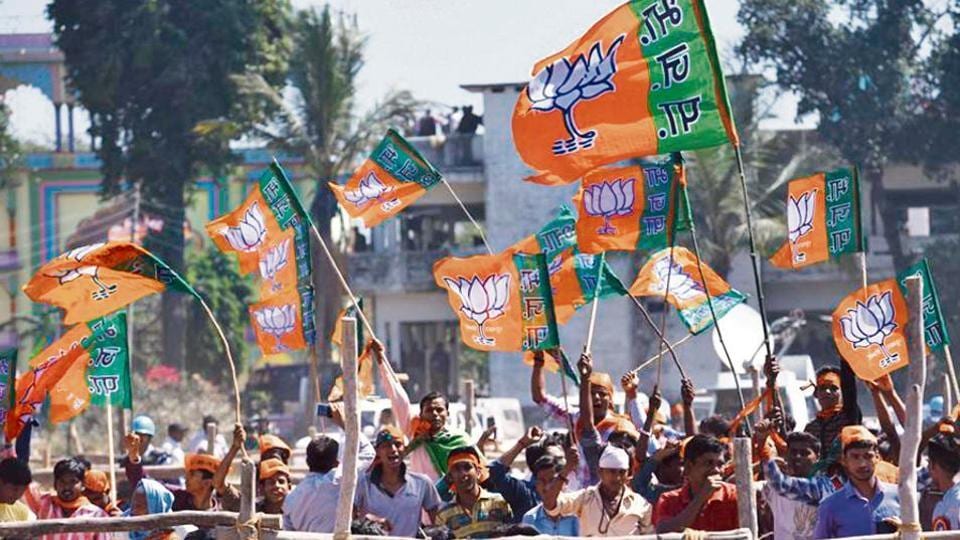
This, according to people aware of the development, is being done to counter the caste arithmetic of the coalition of the Bahujan Samaj Party (BSP) and the Samajwadi Party (SP), arch rivals-turned-allies, which are counting on the support of Dalits, OBCs and minorities. They also have another partner in Ajit Singh’s Rashtriya Lok Dal (RLD) in a state where caste faultlines run deep.
Ahead of Thursday’s second phase of polling in Agra, Aligarh, Amroha, Bulandshahr, Fatehpur Sikri, Hathras, Mathura and Nagina; cadre of the BJP and foot-soldiers of the Rashtriya Swayamsevak Sangh (RSS), its ideological mentor, have been visiting households, particularly in Dalit- and OBC-dominated areas, to talk about the “inclusivity” of central schemes such as the Ujjwala Yojna and Jan Dhan.
Watch - Lok Sabha elections 2019: The big fights to watch out for in Phase 2
Under Ujjawala, the BJP-led government at the Centre is offering free gas connections to poor households. Jan Dhan is aimed at promoting financial inclusion, to ensure that every household has a bank account and access to basic financial services.
Contact programmes have intensified following feedback from the RSS after the April 11 first phase of elections, where the overall polling percentage dipped from 2014’s 66.52% to 63.69%.
While the BJP is counting the 220 million beneficiaries of its various schemes as a pan-India vote bank; the RSS is learnt to have cautioned the party that a dip in the voter turnout could lower its chances of winning. In 2014, the party won 71 of the 80 Lok Sabha seats in UP.
The Sangh’s message to the BJP is to take the message of inclusivity to far- flung and even sparsely populated villages. “We have been given the instruction to knock on every door,” said a volunteer of the RSS on condition of anonymity.
“The BJP faces a challenge in several key seats from the Jat-dominated RLD, the Dalit-centric politics of the Bahujan Samaj Party and the Yadav- and Muslim-dominated politics of the SP. In such a scenario it has to show the voters how selection on the basis of caste will be a wrong choice,” said a senior RSS functionary in Mathura on condition of anonymity.
In Mathura, where the BJP is eyeing half of the 20% OBC vote share and half of the 20% Jat vote share, the party has to assuage the anger of the farmers and tradinc community.
Even as it has promised to double farm incomes by 2022 and claims to have increased the minimum support price of crops to 1.5 times the cost of production, farmers across the state are unhappy over unpaid dues for sugarcane and having to sell their produce in the open market.
In Mathura, for instance, farmers complain that the government, despite announcing that it will purchase wheat at
₹1,840 per quintal, had not done so. “They said all purchases will be done by April 1; they have not even begun and we are being forced to sell in the open market for ₹1,600 per quintal,” a farmer in Mathura said.
Traders of silver, imitation jewellery and faucet manufacturers complain of business being down by as much as 30-40% after the November 2016 invalidation of high-value banknotes. Although they support Prime Minister Narendra Modi for his muscular policy towards Pakistan and the BJP’s overall Hindutva pitch, they also complain that the Goods and Services Tax (GST) had put an additional burden on small-scale enterprises.
Silver and imitation jewellery is like a cottage industry in Mathura; GST has put a strain on traders, who now have to pay large sums to lawyers and chartered accountants to file returns, said a group of traders in Mandi Ramdass.
To defuse anger over the slow delivery or non-delivery of welfare schemes, the Sangh has suggested increasing door-to-door contact programmes. “In some villages only a few farmers have received the money under the Kisan Samman Nidhi, so before that is perceived as a false promise or as a discrimination on caste basis; the party and Sangh workers have been asked to set the record straight and explain that all the beneficiaries will be covered,” the RSS functionary cited above said.
Under Kisan Samman Nidhi, small and marginal farmers are being paid ₹6,000 per annum in three instalments.
Uttar Pradesh power minister Shrikant Sharma said the vote for the BJP will be on the basis of “its achievements”. “In 2014, it was against the Congress’s misrule, now it will be for our good governance. All these caste issues don’t matter,” he said.
In a predominantly Dalit neighbourhood in Mathura, this sentiment finds no takers. Even as a few BJP workers tried to draw attention to central schemes, people complained about the lack of jobs and employment avenues.


